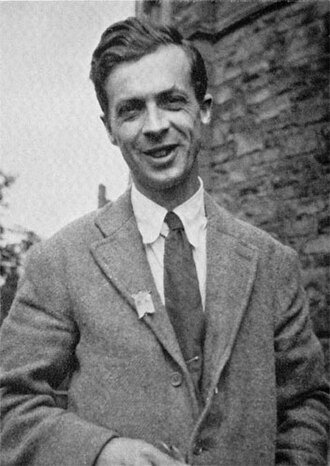
Julian Huxley
1887–1975 · British evolutionary biologist, writer and popular science author, first Director-General of UNESCO
Julian Huxley (London, 1887–1975) was one of the most influential evolutionary biologists of the twentieth century and a tireless popularizer of science. He took part in the modern synthesis, the movement that in the middle decades of the century joined natural selection with genetics. He is also remembered as the first Director-General of UNESCO and as a founder of the World Wildlife Fund. He came from a family of intellectuals: he was the grandson of the biologist T. H. Huxley, Darwin's defender, and the brother of the novelist Aldous Huxley.
He studied at Eton and then at Oxford, where he became interested in embryology and protozoa. After a period at the marine station in Naples, he taught at Oxford and in 1912 moved to the newly founded Rice Institute in Houston, Texas, to help build its biology department. The First World War brought him back to England, where he worked in intelligence. Afterwards he held posts at Oxford and at King's College London, but in 1927 he left teaching to devote himself to writing and popularization. The Science of Life, written with H. G. Wells and G. P. Wells, shows his wish to bring biology to a general readership. In 1935 he became secretary of the Zoological Society of London, a post he was pushed out of in 1941.
His central ideas concern evolution as a process that shapes living things and human culture alike. In his studies of bird behaviour he described courtship rituals and linked them to inherited patterns of conduct, an approach that won him the friendship and influence of Konrad Lorenz. In anthropology and human biology he defended a moderate eugenics, criticised its more extreme forms, and after the Second World War argued that race had no sound biological basis. In 1957 he coined the word "transhumanism" to describe the view that human beings can improve themselves through science and technology, not only through selective breeding.
His influence can be seen in the spread of evolutionary biology, in the organisation of international scientific cooperation through UNESCO, and in nature conservation. He died in London in 1975, leaving a broad body of work that combines research, essay and popular writing.
Key ideas
- Modern synthesis: evolution is explained by combining natural selection with population genetics.
- Courtship ethology: bird rituals are inherited behaviours that can be studied systematically.
- Transhumanism: human beings can improve their capacities through science, technology and the social environment.
- Moderate eugenics: improving the species must be reconciled with social justice and wellbeing.
- Scientific humanism: science can guide shared values and foster international cooperation.
Curiosities
A childhood remark
By his own account, as a boy he interrupted his grandfather at dinner to ask about the stickleback and parental care.
A prophetic remark in Texas
Shortly before the First World War, while working in a laboratory in Texas, he remarked that aircraft would soon be flying over England.
Original Filopedia text based on Wikipedia (es) and Wikipedia (en) and Wikidata.