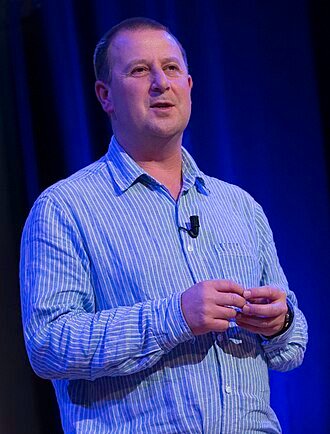
Julian Baggini
b. 1968 · British philosopher, journalist and popular writer
Julian Baggini is a British philosopher, journalist and popular writer, born in 1968 in Folkestone. He has published more than twenty books that bring philosophy to a general readership, and he has also written on atheism, secularism and national identity. He is one of the best-known public voices of philosophy in Britain.
The son of an Italian immigrant father and an English mother, he grew up in Kent and attended Harvey Grammar School in Folkestone. He studied philosophy at the University of Reading, graduating in 1990, and earned a PhD from University College London in 1996 with a thesis on personal identity. In 1997 he co-founded The Philosophers' Magazine with Jeremy Stangroom, and in 1999 he helped set up a humanist philosophy group linked to the British Humanist Association.
His output includes synoptic works such as What's It All About? and The Pig that Wants to Be Eaten, as well as books on Englishness, such as Welcome to Everytown. The Edge of Reason argues for a rational scepticism in an irrational world. How The World Thinks (2018) offers a global history of philosophy that gives weight to traditions beyond the West. His more recent books deal with free will, truth and the philosophy of food.
He writes regularly for The Guardian, the Financial Times and The Wall Street Journal, and in 2019 became academic director of the Royal Institute of Philosophy. His influence lies mainly in bringing hard philosophical questions into everyday public debate.
Key ideas
- Rational scepticism: testing beliefs against reasons and resisting uncritical acceptance, while still leaving room for mystery and ambiguity.
- Personal identity: what it means to remain the same self over time, the subject of his doctoral thesis.
- Free will: a defence of genuine freedom compatible with a world governed by natural laws.
- Global philosophy: the view that philosophical thinking has roots in many cultures, not only in the West.
- Secular humanism: living an ethical life and finding meaning without religion, and defending secular education.
Original Filopedia text based on Wikipedia (en) and Wikidata.