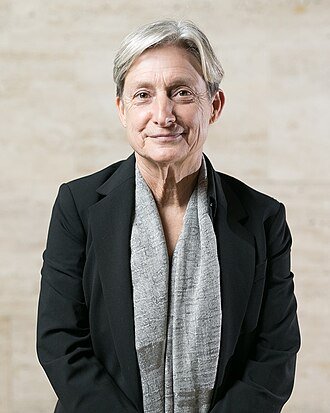
Judith Butler
b. 1956 · American poststructuralist philosopher and founding figure of queer theory
Judith Butler (born in Cleveland in 1956) is an American philosopher of Jewish background and one of the central figures of poststructuralism. Working across political philosophy, ethics and gender studies, Butler has been decisive for feminist and queer theory, and has also shaped literary theory, law and sociology. For this reason they are often cited as one of the most influential voices in contemporary thought.
Butler was born into a family of Hungarian-Jewish and Russian-Jewish descent, and most of their maternal grandmother's family was murdered in the Holocaust. As a child they attended Hebrew school and classes on Jewish ethics, and at around fourteen, as Butler later recalled in an interview, they first became acquainted with philosophy. Butler studied at Bennington College before moving to Yale, where they took a bachelor's degree in 1978 and a PhD in 1984. After a year at Heidelberg University as a Fulbright scholar, they taught at Wesleyan, George Washington and Johns Hopkins, and in 1993 joined the University of California, Berkeley, where they still teach.
Their best-known books are Gender Trouble (1990), which questions conventional notions of gender and sex, and Bodies That Matter (1993), which answers readings that treated performativity as a daily personal choice. In them Butler develops the theory of gender performativity: gender is not a natural essence expressed through behavior, but a set of repeated acts that produce the appearance of a stable identity. To explain this, they draw on J. L. Austin, on the phenomenology of Merleau-Ponty and on Simone de Beauvoir's feminism, and they describe the subject not as a fixed individual but as an open process shaped by language and norms. This leads to a warning against clinging to a single identity, which can end up oppressing, and to the possibility of transforming gender through subversive repetition.
Their influence is wide. Their ideas have become foundations of queer theory and have marked much contemporary feminism, while also fuelling debates about LGBTQ+ rights. In recent years Butler has also written and spoken on war, ethics, democracy and the Israeli-Palestinian conflict, positions that have drawn both support and controversy.
Key ideas
- Gender performativity. Gender is built through repeated acts and gestures, rather than being a natural essence that exists before behavior.
- The subject in process. The subject is not a fixed individual but an ongoing formation, shaped by language and social norms.
- Subversive repetition. Because identity is sustained by repetition, that same repetition can be broken or altered, opening the way to transforming gender.
Where to start
Gender Trouble 1990
It is the most accessible way into Butler and gives the keys to her thinking. It argues that gender is not a natural essence but a repeated, performative practice, and it questions the idea of a fixed identity. Reading it shows why it is considered foundational for queer theory.
Next: Bodies That Matter. Bodies That Matter picks up these ideas and deepens them, examining the material and discursive limits of sex.
Works in Filopedia
- Gender Trouble 1990
- Bodies That Matter 1993
Curiosities
Tutorials as punishment
According to an interview with Haaretz, at fourteen their rabbi assigned them tutorials as a punishment for talking too much in class, and Butler was thrilled by the idea.
A widely read book
Gender Trouble was first published in 1990 and sold over 100,000 copies internationally, in several languages.
Teachers and influences
Influenced by
- Michel Foucault 1926–1984
Influenced
- Axel Honneth b. 1949
Original Filopedia text based on Wikipedia (es) and Wikipedia (en) and Wikidata.