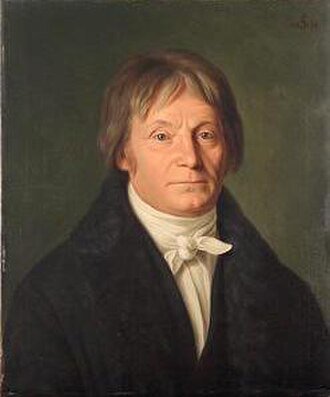
Joseph Görres
1776–1848 · German writer, journalist and thinker
Johann Joseph von Görres (Koblenz, 1776 – Munich, 1848) was a German writer, journalist and thinker whose career moved from enthusiasm for the French Revolution to a militant Catholic conservatism. His path illustrates how ideas about nationhood, press freedom and the role of the Church changed in Germany during the nineteenth century.
Born into a comfortably off family, he was educated at a Latin college run by clergy. As a young man he admired the Revolution and took part in radical clubs in the Rhineland, then under French rule. He published republican papers attacking the French administration. In 1799 he travelled to Paris as part of a delegation seeking independence for the Rhenish provinces. The reception was disappointing, and the experience cooled his republican hopes.
Under Napoleon he lived quietly, teaching at a secondary school and devoting himself to study. He married in 1801 and moved to Heidelberg, where he joined the Romantic circle around Clemens Brentano and Achim von Arnim. He learned Persian and later translated parts of Firdousi's Shahnama. After 1813 he returned to politics as editor of the Rheinischer Merkur, whose hostility to Napoleon brought him considerable influence. His criticism of Prussia and his liberal leanings, however, led to the paper's suppression and to his dismissal from his teaching post in 1816.
He then became a sharp political pamphleteer. Writings on the murder of Kotzebue and on censorship forced him to flee Prussia. In works such as Europe and the Revolution, he looked to religion and to Rome as a counterweight to princes he believed wanted to crush popular liberties. Summoned to Munich by King Ludwig I of Bavaria as professor of history, he spent his later years on Christian mysticism. This work earned admirers and controversy alike, especially his defence of Church authority during the dispute over mixed marriages.
His legacy lies between the liberalism of his youth and the militant Catholicism of his maturity. He was an influential figure in German journalism and in nineteenth-century Catholic debate, and his study of mysticism was widely read for decades, including by the young Carl Jung.
Key works
- Germany and the Revolution (1819): an analysis of censorship and free opinion after the murder of Kotzebue.
- Europe and the Revolution (1821): an account of French moral and political decline in the eighteenth century as a cause of the revolution.
- Athanasius (1837): a defence of Church power that started a long and bitter controversy.
- Die christliche Mystik (1836–1842): a study of Christian mysticism, with biographies of saints and of mystics of his own time.
Curiosities
A Napoleonic nickname
Napoleon reportedly called the *Rheinischer Merkur* "the fifth power", acknowledging the force of its criticism.
A literary portrait
The diarist Henry Crabb Robinson described him with wild features, likening him to an overgrown old student and to Caliban.
Original Filopedia text based on Wikipedia (es) and Wikipedia (en) and Wikidata.