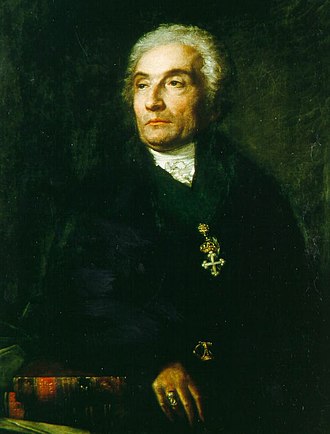
Joseph de Maistre
1753–1821 · Savoyard political philosopher and key figure of the Counter-Enlightenment
Joseph-Marie, comte de Maistre (Chambéry, 1753 - Turin, 1821), was a lawyer, diplomat and philosopher, remembered today as one of the intellectual forefathers of modern conservatism. He lived in the Kingdom of Piedmont-Sardinia and wrote in French, the language of his culture. He opposed the legacy of the Enlightenment and the French Revolution, and defended monarchy and religious authority as the foundations of social order.
He came from a family of French and Italian origin. He was probably educated by the Jesuits, studied law at Turin and in 1787 became a senator in Savoy, as his father had been. In his youth he was a liberal who sympathised with political reform in France and praised the American Revolution. The direction taken by the National Assembly and the decisions of August 1789 led him to reject the revolutionary process.
After French troops occupied Savoy he took refuge in Lausanne, where he moved in the circle of Madame de Staël and began writing counter-revolutionary works. Expelled from Switzerland, he passed through Venice and Sardinia. In 1802 he was sent to Saint Petersburg as envoy to Tsar Alexander I. With few real diplomatic duties, he moved in aristocratic circles and wrote the works for which he is best known. He returned to Turin in 1817 and died there in 1821.
His thought rests on a deep suspicion of reason as a basis for political power. In Considerations on France (1797) he described the Revolution as radically evil and as a providential punishment. For him, any government justified only by rational argument would end in endless disputes over its legitimacy and, from there, in violence. He therefore defended an authority of a different kind, religious and firm, which subjects were not to question. He held that written constitutions were mere « scraps of paper », while genuine institutions matured slowly over time under God's guidance.
In On the Pope (1819) he gave the pontiff a central role as spiritual and temporal guide against historical decline. His Evenings in Saint Petersburg, published after his death in 1821, develop the idea of a Providence that works mysteriously, above all through miracles, to which humans respond with prayer. Although he preferred monarchy, he acknowledged that republics could sometimes be superior, depending on the people and circumstances.
His influence lasted. Later conservative thinkers admired him, and Isaiah Berlin studied his impact on Tolstoy's War and Peace and on the history of reactionary political thought.
Key ideas
- Divine Providence: history and society can only be understood by recognising that God acts within them, even though his purposes remain mysterious.
- The limits of reason: human reason cannot hope to grasp the divine order, since the original perfection was lost through sin.
- Non-rational legitimacy: authority must rest on firm beliefs that are not open to debate, because reason alone would only produce conflict.
- Monarchy and the papacy: a defence of hereditary monarchy and of the Pope as guide against humanity's decline.
Curiosities
A book by his brother
He edited Voyage Around My Room, written by his brother Xavier, which is now regarded as a classic of French literature.
An unusual brotherhood
He belonged to an aristocratic Catholic confraternity, the Penitents Noirs, which sat with condemned criminals on the night before their execution.
A rejected essay
Isaiah Berlin wrote an essay on Maistre and the origins of fascism that the Journal for the History of Ideas rejected in the 1960s; it was not published until 1990.
Teachers and influences
Influenced
- Charles Baudelaire 1821–1867
- Julius Evola 1898–1974
- Jules Amédée Barbey d'Aurevilly 1808–1889
Original Filopedia text based on Wikipedia (es) and Wikipedia (en) and Wikidata.