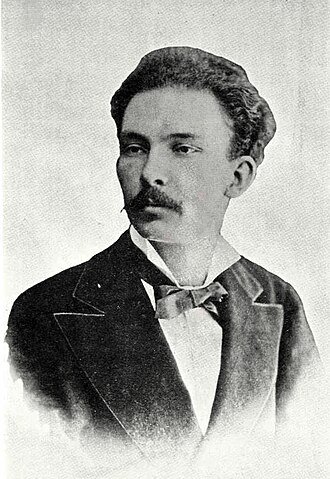
José Martí
1853–1895 · Cuban poet, essayist and politician, national hero of Cuba
Childhood and early years in Cuba
José Julián Martí Pérez was born in Havana on 28 January 1853, when the island was a colony of the Spanish Empire. His father, Mariano Martí, was from Valencia, and his mother, Leonor Pérez Cabrera, came from the Canary Islands. When he was four the family moved to Valencia, but two years later they returned to Cuba. Back on the island, José enrolled in a public school in the Santa Clara district, where his father worked as a prison guard.
Intellectual formation
In 1865 he enrolled at the Escuela de Instrucción Primaria Superior Municipal de Varones, headed by Rafael María de Mendive, a teacher who shaped his political ideas. His closest friend, Fermín Valdés Domínguez, from a wealthy family that owned slaves, shared in the growth of his social and political conscience. In 1866 he entered the Instituto de Segunda Enseñanza in Havana, with his studies financed by Mendive. In 1867 he also enrolled at the Professional School of Painting and Sculpture, known as San Alejandro, to study drawing, though he never found the commercial success he hoped for in that field. He also worked at Mendive's San Pablo school, helping with its administration.
First writings and the Ten Years' War
In 1868 the Ten Years' War broke out in Cuba, and Martí joined, together with Fermín, the clubs supporting the independence cause. He was already writing poems about Cuban freedom. In 1869 he published his first political texts in El Diablo Cojuelo and the verse drama Abdala, whose hero fights for the liberation of an imaginary country called Nubia. That same year he wrote the sonnet
Key ideas
- Political freedom: Cuban and American independence is a basic condition of human dignity.
- Intellectual independence: Spanish America should think and create from its own reality, not merely imitate European models.
- Unity of the independence movement: the Cuban cause required uniting exiles and patriots on the island in one shared project.
- War as organized revolution: emancipation had to be achieved through organized action that avoided excessive suffering for the Cuban people.
Works in Filopedia
- Simple Verses 1891
Books to read
- Amistad funesta: Novela SpanishEPUB 219 KBRead online
- Granos de oro: Pensamientos Seleccionados en las Obras de José Martí SpanishEPUB 110 KBRead online
Curiosities
Posthumous degrees
Martí completed his studies in Zaragoza but could not collect his degrees because he lacked the money to have them issued. The university awarded them posthumously in 1995.
Expelled from Venezuela
An essay he wrote on the intellectual Cecilio Acosta, published in the second and last issue of his magazine, annoyed President Guzmán Blanco and led to his expulsion from the country.
Original Filopedia text based on Wikipedia (es) and Wikipedia (en) and Wikidata.