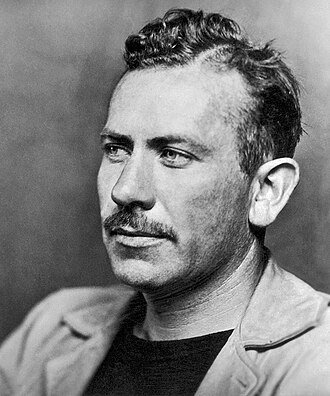
John Steinbeck
1902–1968 · American novelist, Nobel Prize laureate in Literature
Childhood and early years
John Ernst Steinbeck was born on February 27, 1902, in Salinas, California, in the fertile agricultural valley of the same name on the state's central coast. He was the son of John Ernst Steinbeck, Monterey County treasurer, and Olive Hamilton, a former schoolteacher who shared her son's love of reading and writing. The family had German, English and Irish roots: his paternal grandfather, Johann Adolf Großsteinbeck, had emigrated to the United States in 1858 and shortened the family name, while his maternal grandfather, Samuel Hamilton, had been born in Ireland. The Steinbecks were Episcopalians, though the writer later became an agnostic.
Work on the land and youth
During his summers he worked on nearby ranches and later alongside migrant laborers on the Spreckels sugar beet farms. There he came to know the hardships of migrant life and the darker side of human nature, experiences that fed into works such as Of Mice and Men. He walked through the forests, fields and farms around him, and sometimes worked in the laboratory of the sugar company, where he had time to write. He also had a considerable aptitude for mechanics and enjoyed repairing whatever he owned.
Studies and first literary attempts
He graduated from Salinas High School in 1919 and studied English literature at Stanford University, near Palo Alto, but left in 1925 without a degree. He moved to New York City, where he took odd jobs while trying to write, including work on the construction of Madison Square Garden. He wrote as a freelancer for the New York American, which dismissed him; the experience became the essay "Making of a New Yorker," published in 1946. Back in California, he worked in 1928 as a guide and caretaker at Lake Tahoe, where he met Carol Henning, his first wife. They married in January 1930 in Los Angeles, where they tried unsuccessfully to earn a living making plaster mannequins. When their money ran out they moved to Pacific Grove, to a cottage owned by Steinbeck's father, who gave his son free lodging, paper for his manuscripts and loans that allowed him to write without looking for work.
Ed Ricketts and ecological thought
In 1930 he met the marine biologist Ed Ricketts in Monterey, who became his close friend and mentor over the following decade. Ricketts ran a laboratory that sold marine specimens to schools and colleges, and passed on to Steinbeck a grounding in biology and an ecological outlook in which humans are merely one link in a far larger web of life. That view surfaces in the novels of the period. Ricketts served as the model for the character of Doc in Cannery Row and Sweet Thursday, and for figures in In Dubious Battle and The Grapes of Wrath. Together they travelled to the Gulf of California in 1940, and the expedition produced The Log from the Sea of Cortez, a joint work that found little readership when it appeared just as the United States entered the Second World War, and which Steinbeck reissued under his name alone in 1951. Ricketts's early death in 1948 marked, in the view of his biographer, a decline in Steinbeck's writing, East of Eden being the notable exception.
Early books and recognition
His first novel, Cup of Gold (1929), based loosely on the buccaneer Henry Morgan, passed almost unnoticed, as did The Pastures of Heaven (1932), a set of linked stories set in a valley near Monterey. His first real success came with Tortilla Flat (1935), a comic chronicle of young men without work or homes in Monterey after the First World War, whom the author compares ironically to the knights of the Round Table. The novel earned him the gold medal of the Commonwealth Club of California. Then came his run of books on the Depression and farm labour: In Dubious Battle (1936), Of Mice and Men (1937), a short novel about the dreams of two farmhands, which he also adapted for the stage, and The Grapes of Wrath (1939), drawn from articles he had written for the San Francisco News about migrant workers. The last, considered his masterpiece, won the Pulitzer Prize in 1940 and was filmed by John Ford with Henry Fonda. His critical stance on capitalism and his sympathy for Roosevelt's New Deal brought fierce criticism, and Kern County briefly banned the book from its schools and libraries.
War, maturity and later works
During the Second World War he worked as a war correspondent for the New York Herald Tribune and collaborated with the Office of Strategic Services, the forerunner of the CIA. He wrote The Moon Is Down (1942), about resistance in an occupied village, which the Norwegian government later honoured. After the war he published The Pearl (1947), which the Mexican director Emilio Fernández filmed, and Cannery Row (1945), a love letter to Monterey. He travelled to the Soviet Union in 1947 with the photographer Robert Capa, an experience recorded in A Russian Journal. In 1952 he published East of Eden, a saga about good and evil that he regarded as his most ambitious novel, and which Elia Kazan adapted for the cinema with James Dean. He later wrote Travels with Charley (1962), an account of his road trip across the United States with his poodle, and his last novel, The Winter of Our Discontent (1961), on moral decline in American society. That novel was not a critical success, but the Swedish Academy valued his work when it awarded him the Nobel Prize in Literature in 1962, praising his realistic and imaginative writing, which combines sympathetic humour with keen social perception, though the choice was widely debated. In 1967 he went to Vietnam as a correspondent and voiced support for the American war effort, which set him at odds with parts of the progressive press. He died in New York on December 20, 1968, of heart failure.
Reception and legacy
Steinbeck is today one of the most widely read American writers of the twentieth century. Several of his works are part of secondary school curricula in the United States and elsewhere, and some have been banned or removed from classrooms over their language or their portrayal of poverty and social protest. His home region keeps his memory alive: the family house in Salinas, the National Steinbeck Center, Ricketts's laboratory, and a street in Monterey that took the novel's name. His work, shaped by the landscape of California, by working people and by a persistent concern with justice, remains a central reference in American literature.
Key works
- Of Mice and Men (1937): a short novel about two migrant ranch hands and their shared dream of owning a piece of land.
- The Grapes of Wrath (1939): the story of a dispossessed farming family travelling from Oklahoma to California during the Dust Bowl, and his best-known work.
- The Pearl (1947): a parable about a poor pearl diver whose remarkable find brings greed and misfortune to his family.
- East of Eden (1952): a long family saga about good and evil and the freedom to choose.
Quotes
“A writer who does not believe in the perfectibility of man has no dedication or any dealings with literature.”
Discurso de aceptación del Premio Nobel
Where to start
Of Mice and Men 1937
Of Mice and Men is a short, very accessible novel, ideal for a reader without specialist training. It follows George and Lennie, two migrant farm workers in Depression-era California, and portrays with restraint loneliness, the dream of owning a place of one's own, and the harshness of rural labor.
Next: The Grapes of Wrath. The Grapes of Wrath broadens that social vision to a dispossessed migrant family, with epic scope and a strong indictment of injustice, winner of the Pulitzer Prize.
Works in Filopedia
- Of Mice and Men 1937
- The Grapes of Wrath 1939
- East of Eden 1952
Curiosities
A shortened surname
His paternal grandfather, Johann Adolf Großsteinbeck, shortened the family name after emigrating to the United States. The family farm in Heiligenhaus, Germany, still carries the original name.
Real people behind the characters
His wife Carol was the model for Mary Talbot in Cannery Row, and his friend Ed Ricketts inspired Doc in the same novel.
A premiere he skipped
During the New York run of the stage version of Of Mice and Men, he refused to travel to see it, telling director George S. Kaufman that the play in his mind was perfect.
Teachers and influences
Influenced
- Ray Bradbury 1920–2012
Original Filopedia text based on Wikipedia (es) and Wikipedia (en) and Wikidata.