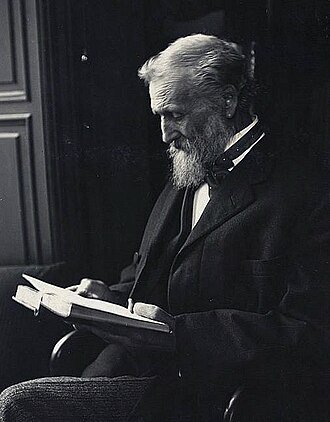
John Muir
1838–1914 · Scottish-American naturalist and pioneer of wilderness conservation
John Muir (Dunbar, Scotland, 1838-Los Angeles, 1914) was a naturalist born in Scotland who spent most of his life in the United States. He is remembered as one of the founders of modern environmentalism and as a tireless defender of wild landscapes, not only for what they could offer people but for their own sake. Over his career he wrote more than three hundred articles and about ten books describing his travels and explorations, and his writing gave him a wide platform for his ideas.
His family emigrated to Wisconsin in 1849, when he was eleven. His father enforced a strict religious routine, and the young Muir learned large parts of the Bible by heart, though his own faith became more personal as he grew older. In 1860 he enrolled at the University of Wisconsin, where he spent two years studying chemistry, geology and botany without ever graduating. He also showed a gift for invention and won prizes at the state fair. An eye injury in 1867 nearly cost him his sight, and the experience pushed him to abandon his factory job and devote himself to exploring nature. That same year he set out on a long walk that took him to the Gulf of Mexico, and from there he made his way west to California.
In California he found the place he loved most, the Yosemite valley and the Sierra Nevada. He studied the glaciers there and argued that the ice had carved the valley, a theory that took time to win acceptance. He married in 1880 and, with his father-in-law, ran a fruit farm for a time, though he never stopped travelling to Alaska, South America, Africa and Australia. In 1892 he founded the Sierra Club, the first major conservation organization of its kind.
His central idea was a near-absolute form of preservation: forests, animals and landscapes should be protected from human exploitation. For Muir, wild nature had a spiritual dimension that enriched people, and looking at a landscape was a way of gaining knowledge. His writing helped build support for Yosemite National Park, established in 1890, and in 1903 he toured the valley with President Theodore Roosevelt. His influence still shapes the American national parks, whose management absorbed much of his philosophy, and since 2013 Scotland has marked a John Muir Day in his honour.
Key ideas
- Complete preservation: plants, animals and natural resources should be placed beyond the reach of human exploitation.
- Intrinsic value of nature: landscapes and species matter in their own right, not only for their usefulness.
- The spiritual dimension of landscape: contemplating nature uplifts the spirit and yields a distinct kind of knowledge.
- Glacial origin of Yosemite: the valley was shaped by ice, an argument through which Muir reinterpreted the geology of the Sierra.
Books to read
- My First Summer in the Sierra EnglishEPUB 229 KBRead online
- The Mountains of California EnglishEPUB 299 KBRead online
- Steep Trails EnglishEPUB 296 KBRead online
- Our National Parks EnglishEPUB 301 KBRead online
- The Yosemite EnglishEPUB 227 KBRead online
- The Story of My Boyhood and Youth EnglishEPUB 216 KBRead online
Curiosities
A lesson under a tree
According to his autobiography, his first botany lesson took place under a black locust beside North Hall at the university. A classmate plucked a flower to show that the tree belonged to the pea family, and Muir later recalled the lesson as the start of his passion for woods and meadows.
A Scot who kept his accent
He spent most of his life in the United States, yet never lost his Scottish accent, since he was already eleven when he emigrated. He carried a collection of poems by Robert Burns on his travels through the American wilderness.
A day in his honour
On 21 April 2013 the first John Muir Day was celebrated in Scotland, marking the 175th anniversary of his birth.
Original Filopedia text based on Wikipedia (es) and Wikipedia (en) and Wikidata.