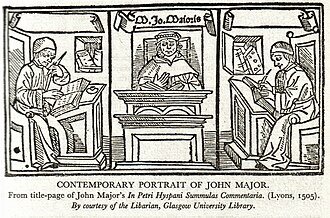
John Major
1469–1550 · Scottish philosopher, theologian and historian
John Major (or Mair, c. 1467-1550) was a Scottish philosopher, theologian and historian, and one of the most followed teachers of his day. Trained and active in Paris, where he taught for decades, he shaped late scholastic thought and influenced later Spanish thinkers such as Vitoria, Soto and Celaya, who learned from him.
He was born at Gleghornie, near North Berwick, and studied at Haddington before leaving for Paris around 1490-1493. There he took his degrees, taught at the Collège de Montaigu and the Sorbonne, and worked under Jan Standonck. He returned to Scotland in 1518 to lead the University of Glasgow, and later went back to Paris. Late in life he became Provost of St Salvator's College in St Andrews, where he died.
His thought moves between logic, natural philosophy and theology. He relied on the close analysis of terms, on the nominalist tradition inherited from John Buridan, and on a sceptical attitude toward the humanists, whose methods he thought less rigorous. In politics he argued that power rests with the people and that councils may stand above the pope. In 1510 he held that the indigenous peoples of the Americas had political and property rights that could not be overridden without compensation.
In his historical work, the History of Greater Britain (De Gestis Scotorum, 1521), he tried to separate myth from documentary evidence, an approach that later Scottish historians such as Hector Boece followed. His influence reached logic, history and international law, though his dry, difficult Latin style gradually lessened his fame.
Key ideas
- Logical nominalism: careful analysis of terms and propositions is the foundation of sound philosophical and theological reasoning.
- Rights of peoples: the indigenous peoples of the Americas hold political and property rights that cannot be violated without compensation.
- Popular sovereignty: political power comes from the people, who may limit their kings.
- Councils over the pope: the authority of general councils may rank above that of the pope.
- History grounded in evidence: a historical account should set aside legend and rest on documents.
Curiosities
Nightmares after a long illness
In his own account, a serious illness he suffered in Paris in 1497 left him with dreams, migraines and an excessive sleepiness that was hard to shake off.
Among friends of Erasmus and Rabelais
According to the sources, he moved in Paris among figures such as Erasmus and Rabelais, sharing with them some reforming concerns.
Teachers and influences
Influenced by
Original Filopedia text based on Wikipedia (es) and Wikipedia (en) and Wikidata.