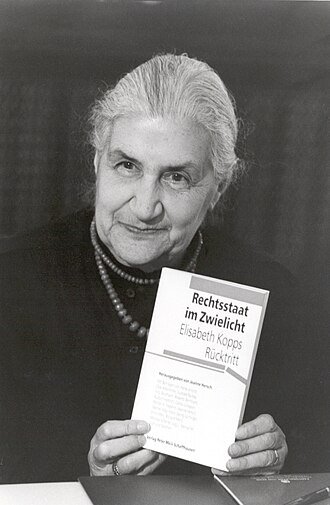
Jeanne Hersch
1910–2000 · Swiss rationalist philosopher of Polish-Jewish origin
Jeanne Hersch (Geneva, 1910–2000) was a Swiss philosopher of Polish-Jewish descent whose work centred on the concept of freedom. Trained in Geneva, with Karl Jaspers in Heidelberg and in Paris, she became one of the best-known philosophers writing in French in the twentieth century.
The daughter of Polish-Jewish immigrants linked to the Bund, a secular Jewish socialist movement, she grew up with ideas of social justice and democracy. She studied at the University of Geneva, and later worked closely with Jaspers, whose major books she translated into French. She taught philosophy, French and Latin at the International School of Geneva before becoming, in 1956, the first woman to hold a chair in philosophy at the University of Geneva. She then led UNESCO's philosophy division and represented Switzerland on its executive board.
For her, freedom was something the individual must defend against governments and ideologies that threaten it. In The Right to Be a Man (1968) she gathered texts from many cultures and periods on human dignity. Later books, such as Illuminating the Obscure and Philosophical Wonder, argued that clear language is the best way to reveal the depth and complexity of a concept, and that questioning apparent certainties is central to philosophy. Her influence endures mainly in French-speaking philosophy and in debates on human rights.
Key ideas
- Freedom: the centre of her work, understood as a demand the individual must defend against forces that threaten it.
- Clarity: precise language is the best tool for illuminating the depth of a concept.
- Philosophical wonder: the capacity to question and doubt apparent evidence is the heart of the philosophical attitude.
- Human dignity: human rights as an expression of a dignity shared across different cultures and periods.
Curiosities
Co-founder of an association
In 1936, shortly after the start of the Spanish Civil War, she co-founded in Geneva, with André Oltramare, the Association of Friends of Republican Spain.
An early prize
At the age of 26 she published her first book, *The Philosophical Illusion*, which won the Amiel Prize of the University of Geneva.
Teachers and influences
Influenced by
- Karl Jaspers 1883–1969
Original Filopedia text based on Wikipedia (es) and Wikipedia (en) and Wikidata.