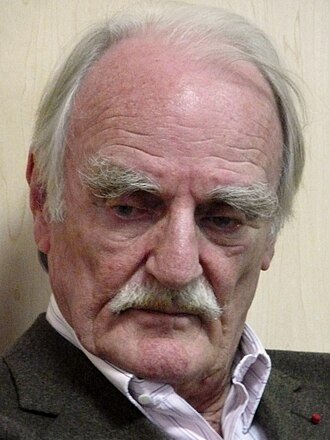
Jean Raspail
1925–2020 · French writer, traveller and explorer
Jean Raspail (Chemillé-sur-Dême, 1925 - Paris, 2020) was a French writer, traveller and explorer who wrote in French for much of the twentieth century. He is best remembered for a 1973 novel about mass immigration to Europe, but most of his output consists of travel books and novels about historical figures, exploration and indigenous peoples.
The son of a factory manager, he was educated at Catholic schools in Paris and at the École des Roches in Verneuil-sur-Avre. In the first twenty years of his career he travelled widely, seeking out communities that he believed were threatened by modernity. In 1951 and 1952 he led a car journey from Tierra del Fuego to Alaska, and in 1954 a French research expedition to the land of the Incas. He also spent a full year in Japan in 1956.
His best-known book, The Camp of the Saints, appeared in 1973. In it he imagines the collapse of Western civilisation under a huge wave of immigration from the Third World. The novel was translated into many languages and, by 2006, had sold more than 500,000 copies. In 1985 he restated its arguments in an article for the magazine Le Figaro, which drew sharp criticism. His traditional Catholicism also shaped several utopian novels in which communism and liberalism fail and a Catholic monarchy is restored, such as Sire (1990). In 1981 his novel Moi, Antoine de Tounens, roi de Patagonie won the Grand Prix du Roman of the Académie Française.
His legacy is mixed. His travel books and historical novels belong to the French tradition of exploration writing. The Camp of the Saints, however, remains the work by which he is known abroad, and his name is still debated because of the views on immigration he expressed.
Key works
- The Camp of the Saints (1973): a novel imagining the collapse of Western civilisation after a wave of migration from the Third World.
- I, Antoine of Tounens, King of Patagonia (1981): a novel about the French adventurer who proclaimed himself king of Patagonia.
- Who Will Remember the People... (1986): a novel that won the Prix Chateaubriand.
- Sire (1990): a utopian novel about the restoration of a Catholic monarchy in France.
- The Ring of the Fisherman (1995): a novel that received the Prince Pierre of Monaco prize.
Where to start
Moi, Antoine de Tounens, roi de Patagonie 1981
Yo, Antoine de Tounens, King of Patagonia is an accessible novel reconstructing the real figure of a French adventurer who proclaimed the independence of a South American kingdom in 1860. Raspail blends travel, history and humor to show an explorer's spirit and obsession, in an engaging story that is highly representative of his view of adventure.
Next: The Camp of the Saints. The Camp of the Saints, his most famous work, shows the dystopian and provocative turn he gave to his thinking about the West and immigration.
Works in Filopedia
Curiosities
Most votes, but no election
In 2000 he was a candidate for the Académie Française and received the most votes, but he did not reach the majority needed to fill the seat vacated by Jean Guitton.
From novel to comic book and television
Several of his novels were adapted: The King's Game became a television film in 1991, and Seven Riders was published as a comic book between 2008 and 2010.
Teachers and influences
Influenced by
- Marcel Jouhandeau 1888–1979
Original Filopedia text based on Wikipedia (es) and Wikipedia (en) and Wikidata.