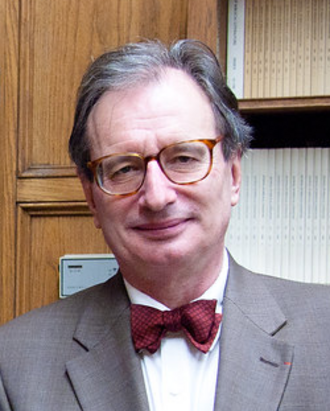
Jean-Luc Marion
b. 1946 · French phenomenologist and Catholic theologian
Jean-Luc Marion (born in Meudon in 1946) is a French philosopher and Catholic theologian whose work sits at the meeting point of phenomenology and theology. He draws on patristic and mystical theology, on the phenomenology of Husserl and Heidegger, and on modern philosophy, which gives him a distinctive place in contemporary French thought.
He studied at the École Normale Supérieure in Paris, where his teachers included Derrida and Althusser, and earned his doctorate in 1980. Alongside his philosophy studies he pursued a private interest in theology, shaped by writers such as Henri de Lubac and Hans Urs von Balthasar. He taught at Poitiers, then at Paris X-Nanterre and the Sorbonne, and from the mid-1990s has worked largely in the United States, at the University of Chicago, where he later held a chair in Catholic studies. In 2008 he was elected to the Académie française.
His early study of Descartes gives his thought its philosophical foundation. His best-known contribution, however, is the notion of the «saturated phenomenon»: an experience that exceeds what can be objectively given and imposes itself on consciousness through an excess of giving. Marion argues that metaphysics fails when it tries to think God as a supreme being, since this reduces God to the onto-theo-logy Heidegger criticised. God becomes accessible instead through the gift and through love, not through transcendental deduction. Works such as God Without Being and The Idol and Distance belong to this line, while The Erotic Phenomenon examines the univocity of love between human beings and toward God.
His influence extends to the phenomenology of religion and to the debate over the 'theological turn' in French phenomenology, which has drawn both support and criticism.
Key ideas
- Saturated phenomenon: an experience that exceeds what can be objectively given and imposes itself on consciousness through an excess of giving.
- The gift: a key to thinking our relation to God and to others, in dialogue with Derrida.
- Critique of onto-theo-logy: metaphysics reduces God to a supreme being, and so fails to reach him.
- Love: a path toward God, which Marion holds to be univocal between human beings and God.
Original Filopedia text based on Wikipedia (es) and Wikipedia (en) and Wikidata.