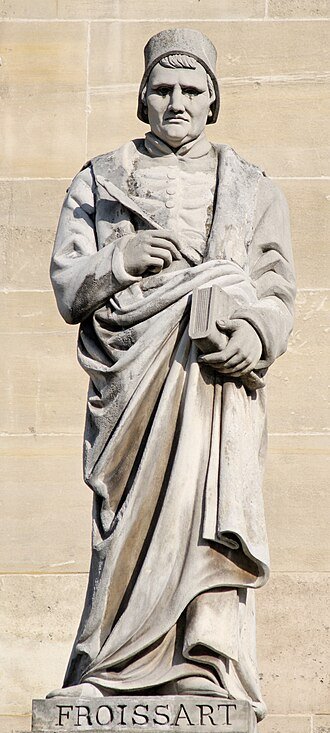
Jean Froissart
1337–1410 · medieval chronicler and poet writing in French
Jean Froissart (Valenciennes, c. 1337 – Chimay, after 1404) was a French-speaking chronicler and poet who worked for the nobility of England and France. Today his writing is a basic source for the first half of the Hundred Years' War.
We know little about his life, and much of that comes from his own writings and from documents that mention him serving noble patrons. Around 1361 or 1362, at about twenty-four, he entered the household of Philippa of Hainault, wife of Edward III of England. For a long time he was described as an official court historian, but archival studies suggest a looser literary relationship: poems dedicated to his lady in return for occasional gifts.
He travelled through Britain, France, Flanders and possibly Spain to gather first-hand accounts. In Milan he attended a wedding in the English royal family, reportedly alongside Chaucer and Petrarch. After Philippa's death he lived on church benefices in Hainaut, which gave him enough money to keep travelling. He returned to England in 1395, disillusioned by what he saw as the end of chivalry. The date of his death is unknown.
His Chronicles, four books covering 1326 to 1400, are his main work. They describe battles, tournaments and customs with great liveliness, but they lack critical distance: he accepts every testimony alike and reflects the prejudices of the nobility, while townsfolk and peasants hardly register. Their value lies in showing the chivalric mindset more than in exact accuracy.
He also wrote the romance Meliador and many lyric and allegorical poems. The Chronicles were copied in more than a hundred manuscripts and remain essential reading for medievalists. His idealised view of chivalry helped give rise to the idea of the autumn of the Middle Ages, a phrase made famous by Huizinga.
Key works
- Chronicles (Chroniques), begun c. 1373: four books on the first half of the Hundred Years' War, lively and partisan in their view of the nobility.
- Meliador, c. 1380: a long verse romance about the heroes of the Arthurian matter.
- L'orloge amoureus (The Amorous Clock): an allegorical poem in which he describes the foliot mechanism of clocks.
Works in Filopedia
Books to read
Curiosities
An English overture
The English composer Edward Elgar wrote an overture titled *Froissart*, inspired by the Chronicles.
A lavishly illustrated copy
One of the most richly illuminated copies, commissioned in the 1470s by the Flemish nobleman Louis de Gruuthuse, contains 112 miniatures.
A clock in literature
He is thought to have been one of the first to mention the verge and foliot escapement in European clocks, by 1368.
Original Filopedia text based on Wikipedia (es) and Wikipedia (en) and Wikidata.