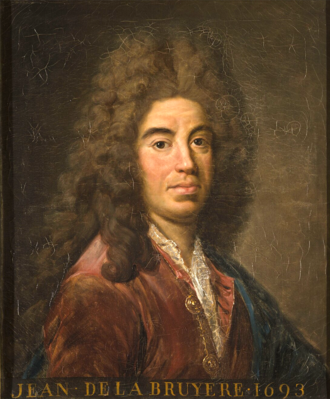
Jean de La Bruyère
1645–1696 · French moralist of the classical period
Jean de La Bruyère (Paris, 1645 – Versailles, 1696) was a French moralist of the seventeenth century, associated with classicism, best known for his satire of court and society. Although remembered as a writer, his work is above all a reflection on human conduct, and it still matters as a sharp record of life at the court of Louis XIV.
He came from a middle-class Parisian family. His father, a financial controller for the city council, was able to pay for a solid education: he was taught by the Oratorians and studied law at Orléans. In 1673 he acquired a post as treasurer general of France in the generality of Caen, which brought him standing and a modest income, although he hardly settled there. From 1684 he served as tutor to the young Duke of Bourbon, grandson of the Great Condé, and he remained afterwards in the Condé household, where he could observe nobles and courtiers at close range. His public life was quiet and is poorly documented.
His main work, Les Caractères, appeared in 1688 as a loose translation of Theophrastus with additions of his own. The book gathers maxims, reflections and short portraits, many with names borrowed from the novels and plays of the day. Its central idea is that human vices and vanities repeat across generations, and that satire can correct manners. His style, with short sentences, sharp contrasts and a deliberate rhythm, invites reading aloud. Each new edition added portraits of people who could be recognised, which earned him many enemies. After several defeats he was elected to the Académie française in 1693. He died in 1696 of a stroke, shortly after the ninth edition of his book appeared. His influence reaches writers such as Marivaux, Balzac, Proust and Gide, who followed his path of the brief sentence and moral observation.
Key ideas
- Moral satire: human faults are constant, and satire exposes them in order to correct them.
- The portrait as method: individual sketches reveal general types within society.
- The broken sentence: pauses and contrasts create surprise and a moral verdict.
- Critique of courtly vanity: social appearance and personal advancement are shown as sources of ridicule.
Books to read
- The "Characters" of Jean de La Bruyère EnglishEPUB 498 KBRead online
- Les caractères FrenchEPUB 402 KBRead online
Curiosities
A disputed surname
His family claimed a crusader ancestor, but according to the sources this was a satirical example of the common practice of self-ennoblement. He himself signed his name as one word, Delabruyère.
A remark against a magazine
He described the Mercure galant as "immediately below nothing", a remark its editors never forgave.
A difficult election
In 1691 he stood for the Académie française and lost; in one ballot he received only seven votes, five of them from friends such as Bossuet and Boileau.
Teachers and influences
Influenced
- George Sand 1804–1876
Original Filopedia text based on Wikipedia (es) and Wikipedia (en) and Wikidata.