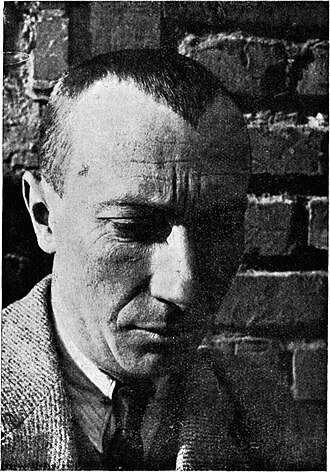
Jean Arp
1886–1966 · Franco-German sculptor, poet and painter
Jean Arp, born Hans Peter Wilhelm Arp, was a sculptor, painter and poet who worked in German and French. He is best known as one of the founders of Dada and as a pioneer of abstract art, and his work shows how organic form could replace strict geometry.
He was born in Strasbourg, then part of the German Empire, to a French mother and a German father. After the region returned to France, French law required him to take the name Jean, although he kept using Hans when speaking German. He published his first poems in Paris in 1904, after training at a school of arts and crafts in Strasbourg. He then studied in Weimar from 1905 to 1907 and returned to Paris in 1908 to attend the Académie Julian.
In 1915 he moved to Switzerland to take advantage of its neutrality. He later told a story, probably embellished over time, of how he avoided conscription by filling in an army form with the same date on every line and adding the figures up in a deliberately absurd way. That year he also met the Swiss artist Sophie Taeuber, who became his close collaborator and a lasting influence on his methods. In 1916 he was a founding member of the Dada movement in Zürich, around the Cabaret Voltaire. He later joined the Cologne Dada group and in 1925 showed work in the first Surrealist exhibition in Paris, but in 1931 he broke with Surrealism and helped found Abstraction-Création.
His work mixed automatism and dreamlike imagery with organic forms, which came to be called biomorphic sculpture. He started with collages, reliefs and assemblages, and from the 1930s extended his practice to bronze and stone. He wrote poetry and essays until his death. During the German occupation of France he fled Meudon and lived in Zürich until the war ended. After 1945 he received public commissions and international recognition, including a relief for Harvard, a mural for UNESCO in Paris, and the Grand Prize for sculpture at the Venice Biennale in 1954. A retrospective at MoMA in New York in 1958 strengthened his reputation.
His legacy is preserved in several foundations, among them the Fondation Arp in Clamart, which keeps the studio where he lived and worked for much of his life, and the Musée d'art moderne et contemporain in Strasbourg, which holds many of his paintings and sculptures. His influence can be seen in later abstract sculpture and in the idea that organic form can shape space as effectively as geometry.
Key works
- Evocation of a Form: Human, Lunar, Spectral (1950), bronze sculpture
- Cloud Shepherd (1953), bronze sculpture
- Feuille se reposant (1959), bronze sculpture
- Trousse d'un Da (1921), assemblage from his Dada period
Curiosities
A recruitment form
He later said that he avoided the German army by filling a form with the same date in every box and adding them up. The authorities reportedly believed he was mentally ill.
A name set by law
When France regained Strasbourg after the First World War, French law required him to be called Jean, though he still used Hans when speaking German.
Original Filopedia text based on Wikipedia (es) and Wikipedia (en) and Wikidata.