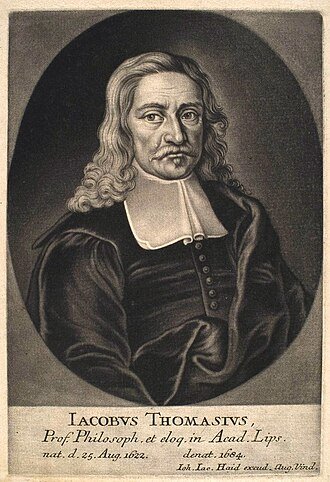
Jakob Thomasius
1622–1684 · German jurist, theologian and philosopher
Jakob Thomasius (Leipzig, 1622–1684) was a German jurist, theologian and philosopher, regarded today as one of the founding figures of positive law and of the historical study of philosophy. He trained at Leipzig and Wittenberg in the orthodox scholastic tradition, whose Aristotelian metaphysics he would later question. He matters because his work helped move university thinking toward a more modern outlook.
From 1652 he taught moral philosophy at the Nikolaischule in Leipzig, becoming its rector in 1670, and from 1676 until his death he led the Thomasschule. A polymath in the old sense, he wrote on subjects as varied as the intellectual education of women, which he defended, and literary plagiarism. His Philosophia practica (1661) and Schediasma historicum (1665) reflect his concern with ordering moral practice and reconstructing the history of philosophical ideas.
His eclectic views aimed to separate philosophy from the Aristotelian metaphysics that dominated the university, a shift that prepared the ground for modern philosophy. He supervised the graduation thesis of Gottfried Leibniz on the principle of individuation, and the two remained friends and correspondents. His influence passed largely through his son Christian Thomasius, the leading figure in philosophy of law in the following century.
Key ideas
- Criticism of scholastic metaphysics: he rejected the inherited Aristotelian metaphysics as the basis of teaching and sought a clearer, more orderly philosophy.
- Eclecticism: he drew on different currents what seemed useful to him, without committing to a single school.
- History of philosophy: he regarded the study of the philosophical past as a discipline in its own right, demanding rigour and method.
- Practical philosophy: he centred reflection on human conduct and the norms that govern it.
Curiosities
An early attack on Spinoza
He is credited with the first published attack on Spinoza's Theological-Political Treatise, which is among the works he is best remembered for today.
Two marriages
In 1653 he married Maria Weber, daughter of the archdeacon of St. Nicholas's Church. After her death he remarried in 1664, to the widow of the rector of St. Peter's School.
Teachers and influences
Pupils
- Gottfried Wilhelm Leibniz 1646–1716
Influenced
- Gottfried Wilhelm Leibniz 1646–1716
Original Filopedia text based on Wikipedia (es) and Wikipedia (en) and Wikidata.