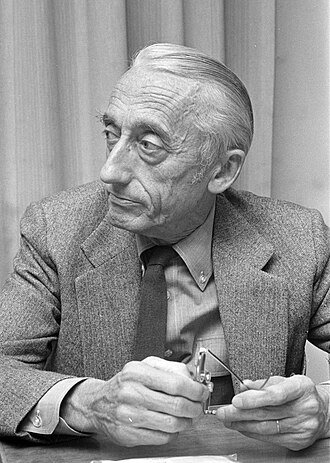
Jacques Cousteau
1910–1997 · French naval officer and underwater explorer
Jacques-Yves Cousteau (Saint-André-de-Cubzac, 1910 - Paris, 1997) was a French naval officer who spent much of his life exploring, studying and filming the sea. He is closely associated with modern diving, with science on television and with the early campaigns to protect the marine environment.
Born in the Gironde, he spent a few years in the United States in the early 1920s, where he first tried swimming and breath-holding in a Vermont lake. Back in France he entered the naval school in 1930 and trained as a gunnery officer. A car accident in 1935 ended his hopes of becoming a naval pilot. While recovering in Toulon he met Philippe Tailliez, who lent him a pair of Fernez goggles, and that experience turned him toward underwater exploration.
During the Second World War he befriended the filmmaker Marcel Ichac, who shared his wish to show the public places they could never reach. In 1942 he made Par dix-huit mètres de fond with Tailliez and Frédéric Dumas, one of the first French underwater films. The next year he shot Épaves using prototypes of the Aqua-Lung, the breathing apparatus he developed with Émile Gagnan. He also improved an earlier design by Yves Le Prieur with a demand regulator, which allowed longer dives.
After the war the Navy asked him to set up a diving research group at Toulon. In 1948 he led a Mediterranean campaign aboard the Élie Monnier, which also explored the Roman wreck at Mahdia in Tunisia, regarded as one of the first archaeological operations using independent diving. He left the Navy in 1949 and in 1950 founded the French Oceanographic Campaigns. For a symbolic franc a year he obtained a ship called Calypso, which he turned into a floating laboratory.
His first book, The Silent World, appeared in 1953 and recounts his dives. In it he noted that porpoises following his ship through the Strait of Gibraltar seemed to know the best route, which led him to suggest they had a form of echolocation. The film version, co-directed with Louis Malle, won the Palme d'Or at Cannes in 1956 and an Academy Award for Best Documentary the following year. He then hosted The Undersea World of Jacques Cousteau (1966-1976), broadcast around the globe, which made his name a byword for underwater documentary.
He was also among the first activists against marine pollution. In 1960, when radioactive waste was due to be dumped at sea, he launched a publicity campaign; according to accounts, women and children sat on the railway tracks to stop a train carrying the waste. In 1973 he founded the Cousteau Society, which grew to more than 300,000 members. From 1992 he advised the United Nations and the World Bank.
He died of a heart attack in Paris on 25 June 1997. His legacy is mixed. Some scientists criticised his popular way of presenting research, yet that style went on to shape modern television. The societies he founded remain active.
Key works
- The Silent World: A Story of Undersea Discovery and Adventure (1953), written with Frédéric Dumas: an account of his early underwater exploration and the Aqua-Lung.
- Par dix-huit mètres de fond (1942): a pioneering French underwater film, awarded in 1943.
- The Silent World (1956): the film version, co-directed with Louis Malle, which won the Palme d'Or at Cannes.
Curiosities
A ship for a symbolic franc
Thomas Loel Guinness leased the Calypso to Cousteau for a symbolic franc a year. Cousteau refitted it as his laboratory and base for filming.
A number one song
In 1975 John Denver wrote the song «Calypso» as a tribute to Cousteau and his ship. It reached number one on the Billboard chart.
An album by Jean-Michel Jarre
In 1990 the French composer Jean-Michel Jarre released the album *Waiting for Cousteau*, whose first three tracks are named after the ship.
Original Filopedia text based on Wikipedia (es) and Wikipedia (en) and Wikidata.