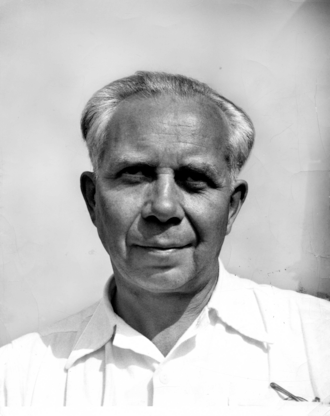
Ivar Lo-Johansson
1901–1990 · Swedish novelist of the proletarian school
Ivar Lo-Johansson (Ösmo, 1901 – Stockholm, 1990) was a Swedish writer associated with the proletarian school, whose work gave a vivid voice to farm labourers and city workers. He matters because he brought the lives of people rarely seen in Swedish literature to the centre of the page, and because his books helped fuel the debate that eventually changed the country's farm labour system.
Born into a family of farm workers hired by the year, he adopted the surname Lo-Johansson in his twenties, although the authorities ended up registering him under a different name. In the 1920s he travelled around Europe, and his first books were travel accounts of working life in France and England. He then turned to novels, short stories and journalism about labourers, trade unions and urban poverty.
His most persistent subject was the situation of the statare, the Swedish farm labourers bound to indentured contracts. His realistic, detailed stories worked as a critique of inequality, and he is credited with helping to pave the way for the end of that system in 1945. His style pairs close observation with a viewpoint that stays on the side of those at the bottom. He also wrote about pensioners, Romani people and others without privilege, which drew considerable controversy.
In the 1950s he published an eight-novel autobiographical series. Later, beginning with Pubertet in 1978, he wrote a sequence of memoirs that won the Nordic Council's Literature Prize. His legacy lives on in Stockholm: his apartment on Bastugatan became a museum shortly after his death, and since 1986 the Swedish Trade Union Confederation has given a literary prize in his name, the first of which went to him.
Key works
- Godnatt, jord (1933): an early novel depicting landless peasants.
- Statarna (1936–37): stories about the indentured farm labourers of Sweden.
- Bara en mor (1939): a novel on human suffering seen through the wife of a farm servant.
- Analfabeten (1951): the first volume of his autobiographical series, on the tension between individual and collective.
- Pubertet (1978): a memoir that opened the final phase of his work and brought him wide recognition.
Curiosities
A disputed surname
Lo-Johansson began using the name Lo in his twenties, claiming it was a family name. When he tried to register it, the authorities ended up recording him as Karl Ivar Loe.
An apartment turned museum
He had lived since 1934 in an apartment on Bastugatan in Stockholm, which became a museum shortly after his death in 1990.
The first prize in his name
The Swedish Trade Union Confederation awards a literary prize in his honour, and he was its first recipient in 1986.
Original Filopedia text based on Wikipedia (es) and Wikipedia (en) and Wikidata.