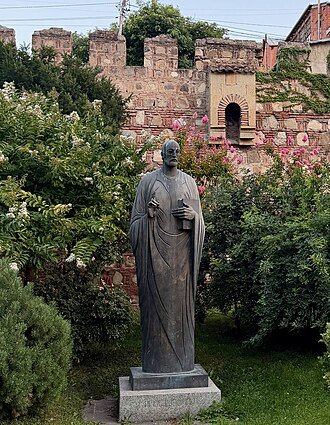
Ioane Petritsi
1050–1200 · Georgian Neoplatonic philosopher
Ioane Petritsi (11th–12th century) was a Georgian philosopher of the Neoplatonic tradition, active both in the Byzantine Empire and in the Kingdom of Georgia. He is best known for his translations of Proclus and for an extensive commentary on that work, and he is often regarded as the most significant Georgian medieval philosopher.
According to tradition, he came from an aristocratic family in Samtskhe, in southern Georgia, and was educated in Constantinople under Michael Psellos and John Italus. After Italus fell from favour, Petritsi seems to have fled to the Georgian monastery of Petritsoni in Bulgaria, which gave him his epithet. He translated many philosophical works, mostly Neoplatonic, aiming to reconcile Classical thought with the message of Christianity. His wide-ranging outlook brought him into conflict with Georgian patristic orthodoxy, until King David IV gave him a place at the Gelati Academy. Besides Aristotle, Proclus, Nemesius and Ammonius Hermiae, he translated biblical and hagiographic texts and wrote hymns and ascetic and mystical poetry. His influence shaped Georgian philosophy and literature, and grew more prominent in the eighteenth century under the reformist scholar Catholicos Anton I.
Key ideas
- Reconciling Classical philosophy and Christianity: he sought to show that Greek ideas could be brought into harmony with the Christian message.
- Proclus and Neoplatonism: his extensive commentary on Proclus and Neoplatonism is his most important original work.
- Mystical and ascetic poetry: he combined philosophical reflection with poetic expression of the spiritual life in his hymns.
Curiosities
Origin of his epithet
His epithet Petritsi is believed to come from the Georgian monastery of Petritsoni in Bulgaria, where he may have taken refuge after the fall of John Italus.
Another name
In later sources he also appears as Ioane Chimchimeli, a name by which he is sometimes referred to alongside his usual one.
Teachers and influences
Teachers
- Michael Psellos 1018–1078
Original Filopedia text based on Wikipedia (en) and Wikidata.