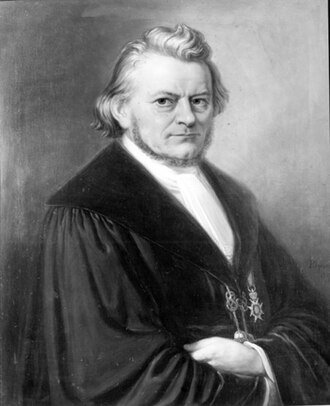
Immanuel Hermann Fichte
1796–1879 · German theist philosopher, son of Johann Gottlieb Fichte
Immanuel Hermann Fichte (Jena, 1796 – Stuttgart, 1879) was a German philosopher and the son of Johann Gottlieb Fichte. At a time when Hegelianism dominated German thought, he defended a theistic philosophy. He studied at the University of Berlin, graduated in 1818 and became a lecturer there. He attended Hegel's lectures but distrusted what he saw as their pantheistic tendencies.
After teaching at secondary schools in Saarbrücken and Düsseldorf, he became a professor at the University of Bonn in 1836 and moved to the chair at Tübingen in 1842, where he taught until his retirement in 1875. In 1837 he founded the journal Zeitschrift für Philosophie und speculative Theologie, which he edited for decades and which became the vehicle for his views on the philosophy of religion.
His central aim was to ground the personality of God philosophically, a view he called "concrete theism". God would not be an impersonal absolute but an infinite Person who wishes to realise himself in finite persons, whom he loves. He tried to reconcile Hegel's monism and Herbart's individualism through Leibniz's monadism, and he proposed an ethical theism grounded in moral experience. His influence was limited, partly because of tensions in his thought and his conciliatory style.
Key ideas
- Concrete theism: God is an infinite Person who relates to finite persons, not an impersonal absolute.
- Critique of Hegel: in his view Hegelianism is a form of pantheism that diminishes human personality and moral demands.
- Personality and monadism: finite personality is understood through Leibniz's monadism, reconciling monism and individualism.
- Ethical theism: moral experience is the decisive test for judging any philosophical system.
Original Filopedia text based on Wikipedia (en) and Wikidata.