Yajnavalkya
800 BC–700 BC · Vedic sage and philosopher of ancient India
Yajnavalkya is a legendary figure of the Vedic period in India, a sage (rishi) whom tradition places between the eighth and seventh centuries BCE. He appears as one of the most prominent voices in the Upanishads, the philosophical texts that close the Vedas, and his name is linked to the idea of Brahman, the Absolute that Hinduism regards as the ultimate ground of reality. His name probably means 'the one who speaks at the fire sacrifices'.
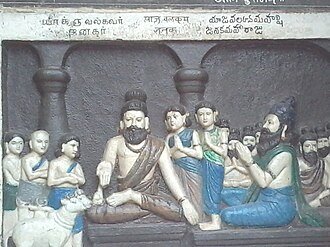
According to tradition, he was the son of Devarata and a pupil of the sage Vaishampayana. A legend, which he himself is said to have told, relates that his teacher grew angry at his pride as the best student and demanded that he return everything he had learned. Yajnavalkya vomited up the knowledge, and his fellow pupils swallowed it, believing it to be the young man's wisdom. From then on he refused to have any human teacher and turned to the sun god Surya, who, in the form of a horse, gave him portions of the Yajurveda unknown to others. He arranged them into fifteen branches and passed them on orally, since writing had not yet been developed in India. He is also traditionally credited with the Shatapatha Brahmana, which includes the Brihadaranyaka Upanishad, where his dialogues with his wife Maitreyi and with King Janaka are recorded.
His central thought is expressed in the method of neti neti, 'not this, not this', by which the Absolute is described through negation, since no determination exhausts it. The Brihadaranyaka also attributes to him astronomical observations on the synchronisation of the Sun and Moon every 95 years, though he still believed that all heavenly bodies revolved around the Earth.
His influence endures in Hindu thought. He is regarded as one of the earliest major speculators of the Vedanta and is credited with promoting renunciation, or sannyasa, as an ideal of life. Transmitted for centuries through oral tradition, his figure remains a model of the quest for ultimate knowledge.
Key ideas
- Neti neti: the Absolute is described by negation, 'not this, not this', because no determination can exhaust it.
- Brahman and Atman: the essence of the individual and the ground of the universe are ultimately one and the same reality.
- Immortality and wealth: possessions do not lead to immortality; only knowledge of the Absolute can.
- Renunciation: leaving family life and property behind as a path toward wisdom.
Curiosities
The vomited knowledge
According to a legend he himself is said to have told, he vomited up everything he had learned in front of his teacher, and his classmates ate it. This is why he chose to have no human teacher.
A contest of wisdom
At the court of King Janaka he took part in a contest to choose the greatest knower of Brahman, and he won after defeating many experienced sages.
Original Filopedia text based on Wikipedia (es) and Wikipedia (en) and Wikidata.