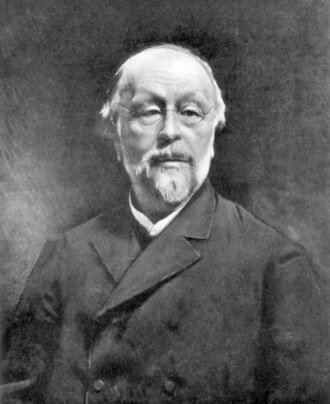
Hippolyte Taine
1828–1893 · French philosopher, historian and critic, theorist of literary naturalism
Hippolyte Taine (Vouziers, 1828 – Paris, 1893) was a French historian, critic and philosopher, and one of the chief theoretical influences on literary naturalism. He lived through a France shaped by upheaval, from the Second Empire to the defeat by Prussia in 1870, and his work sits where positivist philosophy, history and art criticism meet. He matters because he tried to explain literature and art as the products of identifiable causes rather than as the isolated achievement of genius.
Born into a prosperous family from the Ardennes, Taine lost his father at thirteen and was sent to a boarding school in Paris. He excelled in his studies and entered the École Normale Supérieure in 1848. His independence of mind and his rejection of the ideas of Victor Cousin cost him the national philosophy examination in 1851. He turned to literature instead, took a doctorate at the Sorbonne in 1853 with a thesis on La Fontaine's fables, and taught in Nevers and Poitiers. He then wrote for the Revue des deux Mondes and the Journal des débats, and published travel writing and literary history, including his History of English Literature. Later he taught the history of art and aesthetics at the École des Beaux-Arts, and in 1878 he was elected to the Académie Française.
In philosophy he moved away from spiritualism and drew on the ideologues and on Auguste Comte. In On Intelligence (1870) he proposed a scientific, experimental psychology grounded in physiology. In aesthetics he argued that a work emerges from three forces: race, milieu and moment. His Philosophy of Art applied this scheme to painting and literature, and he sought in each author a dominant faculty that shaped what that author expressed. The method attracted many followers, but critics faulted it for schematism and for failing to account for the formal qualities of individual works. His essays on Balzac and Stendhal, by contrast, are still admired as perceptive criticism.
His major historical work, The Origins of Contemporary France, appeared between 1875 and 1893 and examined the causes of the Revolution. Taine blamed it on abstract, rationalist constructions that clashed with the slow, natural growth of institutions. His influence was wide: on Zola and naturalism, on conservative French historiography, and in Spain, where Unamuno, Ganivet and Pardo Bazán read him closely.
Key ideas
- Causal explanation of art: a work of art or literature is explained by the race, milieu and historical moment that shape it.
- Scientific psychology: the mind should be studied by experimental method, with attention to its physiological basis.
- Dominant faculty: each author is defined by a central capacity that guides his whole output.
- Critique of political rationalism: in his view, the Revolution tried to impose abstract designs on institutions that had grown slowly and naturally.
Books to read
- The French Revolution - Volume 3 EnglishEPUB 719 KBRead online
- The French Revolution - Volume 2 EnglishEPUB 567 KBRead online
- The Modern Regime, Volume 1 EnglishEPUB 503 KBRead online
- The Ancient Regime EnglishEPUB 595 KBRead online
- Histoire de la Littérature Anglaise (Volume 4 de 5) FrenchEPUB 442 KBRead online
- The Modern Regime, Volume 2 EnglishEPUB 375 KBRead online
- Histoire de la Littérature Anglaise (Volume 2 de 5) FrenchEPUB 486 KBRead online
- The French Revolution - Volume 1 EnglishEPUB 494 KBRead online
- A Tour Through the Pyrenees EnglishEPUB 334 KBRead online
- History of English Literature Volume 2 (of 3) EnglishEPUB 825 KBRead online
- The Philosophy of Art EnglishEPUB 137 KBRead online
- Le positivisme anglais: Etude sur Stuart Mill FrenchEPUB 129 KBRead online
Curiosities
A hypnosis session at the Salpêtrière
In 1885 he visited the Salpêtrière Hospital, where he attended a session with Joseph Delboeuf in which Jean-Martin Charcot produced blisters by suggestion.
A grave by Lake Annecy
He was buried in the Roc de Chère nature reserve at Talloires, on the shores of Lake Annecy.
Teachers and influences
Influenced
- Friedrich Nietzsche 1844–1900
- Bolesław Prus 1847–1912
- Paul Bourget 1852–1935
Original Filopedia text based on Wikipedia (es) and Wikipedia (en) and Wikidata.