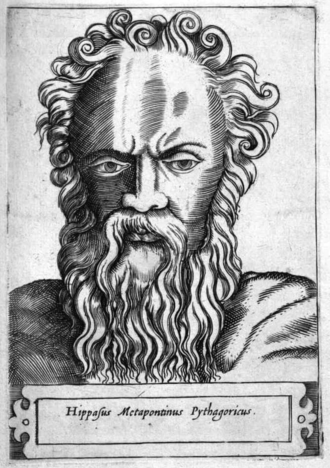
Hippasus
600 BC–500 BC · Greek Presocratic philosopher and mathematician of the Pythagorean school
Hippasus of Metapontum was a Greek philosopher and mathematician of the early Pythagorean tradition. His dates are uncertain; he is usually placed in the late fifth century BC, though the sources do not agree. He matters chiefly because ancient writers link him to geometry, music theory and the first challenges to the Pythagorean belief that everything could be expressed as a ratio of whole numbers.
He was probably born in Metapontum, a Greek city on the Gulf of Taranto in southern Italy, although later writers also assign him to Croton or Sybaris. According to Iamblichus, the school was divided between the Mathematici, who learned the full doctrine, and the Acusmatici, who kept to memorised precepts treated as sacred rules; the sources disagree about which group Hippasus led or founded. He is credited with building a dodecahedron inscribed in a sphere and with experiments on sounding bronze discs, but none of his own writings survive.
Diogenes Laertius reports his view that the universe is limited, always in motion, and that its changes are completed within a definite period. Other sources say he took fire to be the origin of all things, which set him apart from the Pythagoreans, who placed the principle in number.
The famous story that he discovered irrational numbers and was drowned at sea as a punishment is late and probably legendary. The earliest accounts often do not name him at all, and the proof that the square root of two is irrational is ancient but cannot securely be credited to him. His lasting significance lies in the questions he raised about number and geometry, and in the dramatic figure that later tradition built around his name.
Key ideas
- Irrational magnitudes: he is credited, without firm evidence, with early thinking about quantities that cannot be expressed as a ratio of whole numbers.
- Fire as the arché: the origin of all things would be a material, changing element rather than an incorporeal number.
- A limited, moving cosmos: the universe would have bounds, and its changes would follow a fixed cycle of time.
- Music as proportion: through sound experiments he studied the numerical ratios of consonant intervals.
Curiosities
A character in a short film
Hippasus appears in the short film «La proporción Áurea», which is about the irrational number Φ. He provides the film's comic side.
Teachers and influences
Influenced
- Heraclitus 534 BC–470 BC
Original Filopedia text based on Wikipedia (es) and Wikipedia (en) and Wikidata.