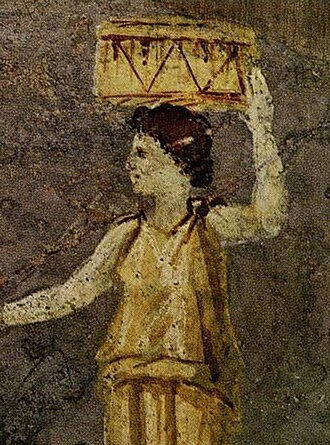
Hipparchia of Maroneia
349 BC–279 BC · Greek Cynic philosopher
Hipparchia was a Greek Cynic philosopher, born in Maroneia, in Thrace, around 350 BC. She is regarded as one of the first women to practise philosophy in a recognised way. Her importance lies both in her ideas and in the way of life she chose, which was highly unusual for a woman in ancient Greece.
Her family was well off. After Philip's conquest of Maroneia, they moved to Athens, where her brother Metrocles, himself a Cynic, became a pupil of Crates of Thebes. According to tradition, Hipparchia fell in love with Crates and threatened to take her own life if her parents refused to let her marry him. To dissuade her, Crates stripped naked and told her that this was her bridegroom and that these were all his possessions. She accepted, and adopted the Cynic way of life: she dressed as he did, appeared with him in public and shared his existence under the porticoes of Athens. The union was said to be called 'cynogamy', a play on the name of the school, which derives from the Greek word for dog.
Her philosophical work seems to have focused mainly on logic. According to the Suda, she wrote several treatises, including Philosophical Hypotheses and Epicheiremata, along with questions addressed to Theodorus the Atheist, but none has survived. A surviving epigram attributed to Antipater records her claim to have chosen the manly life of the Cynic over the customs of her sex. She is also said to have challenged Theodorus with a sophism at a dinner party, and when he tried to shame her for studying rather than attending to domestic tasks, she calmly replied that she had traded the loom for philosophy.
Her significance lies in embodying the Cynic ideal of equality between the sexes and among all people. Her death is dated, without certainty, to around 280 BC, and it is said that the Cynics held an annual festival in her honour in Athens. Her story was revived in later centuries, from the Renaissance to literature and twentieth-century feminist thought.
Key ideas
- Equality in philosophy: the capacity to reason and to live philosophically does not depend on sex.
- Living in accordance with nature: coherence between what one thinks and how one lives, regardless of social convention.
- Contempt for convention: rejection of respectable ways of living when they conflict with reason and virtue.
- Logic and argument: interest in syllogisms and clever arguments as tools of philosophy.
Curiosities
'Cynogamy'
According to tradition, Crates called their union 'cynogamy', a play on the Greek word for dog, from which the name of the Cynic school derives.
Theodorus' sophism
According to the account, Theodorus tried to humiliate her by stripping her in public, but she remained unruffled and answered him calmly.
Original Filopedia text based on Wikipedia (es) and Wikipedia (en) and Wikidata.