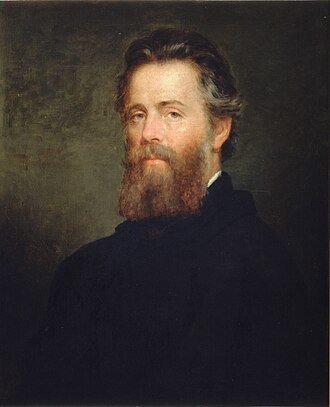
Herman Melville
1819–1891 · American novelist, poet and essayist
Childhood and education
Herman Melville was born in New York City on August 1, 1819, the third of eight children of Allan Melvill, a merchant of Boston origin, and Maria Gansevoort. Both grandfathers had fought in the American Revolution: Major Thomas Melvill, who took part in the Boston Tea Party, and General Peter Gansevoort, who defended Fort Stanwix in 1777. Melville would later take pride in his "double revolutionary descent". His mother belonged to a family of strict Dutch Calvinist tradition, and she gave him a thorough knowledge of the Bible, which he read in English and in Dutch.
The 1820s passed in a comfortable household with several servants and frequent moves to ever grander houses, yet the family's finances rested on debt. Melville began school at five or six and attended schools in New York and, after the family moved to Albany in 1830, the Albany Academy. Allan Melvill died in January 1832, ruined and, according to some accounts, a suicide that the family covered up for religious reasons. After his death, the young Herman worked as a clerk in a bank and in his brother's cap and fur store, and he taught at rural schools in Massachusetts. His education was irregular and largely self-directed, and his brother Gansevoort was his main support and intellectual reference.
First voyages
In 1839 he signed on as a green hand aboard the merchant ship St. Lawrence, sailing from New York to Liverpool, an experience he would later draw on for Redburn. After a failed attempt to find work in Illinois, he enlisted in 1841 on the whaler Acushnet, bound for the South Seas. The voyage lasted about eighteen months. In the Marquesas Islands, at Nuku Hiva bay, he deserted with a shipmate, Richard Tobias Greene, and the two fell into the hands of the Taipi, a people the sailors regarded as cannibals. Melville stayed with them for about a month, long enough to observe a society that seemed to him more orderly and generous than the ships on which he had served.
His next stops took him to Tahiti, where he took part in a mutiny and was briefly imprisoned, to the Society Islands, to Lahaina in Hawaii, and finally aboard the American frigate United States, on which he served as an ordinary seaman until he landed in Boston in October 1844. This journey of nearly four years gave him a store of experience he never ceased to exploit and, as scholars such as Robert Milder have argued, a sense of metaphysical estrangement before an ocean that seemed abandoned by God, along with an outsider's view of Western culture.
The success of Typee and Omoo
Back on land, with little money and no trade, Melville found that people were eager to hear his stories. Encouraged by other sailors' memoirs, he wrote Typee, published in London in February 1846 and in New York the following month, with immediate acclaim and strong sales. Nathaniel Hawthorne, who reviewed the book anonymously, praised the freedom of its gaze on customs unlike our own. The book mixed adventure, ethnography and social criticism in a warm tone that gave fresh life to the South Sea idyll.
The success prompted Omoo (1847), a sequel set in the Society Islands. Both books brought him notoriety and admitted him into literary circles in New York. Melville was also a popular oral storyteller, and the editor Nathaniel Parker Willis described him recounting his adventures much as he wrote them. With the money he earned he married, in August 1847, Elizabeth Knapp Shaw, daughter of the Boston jurist Lemuel Shaw, a close friend of his father.
Ambition and commercial failure
His third novel, Mardi (1849), marked a break: it was a work of pure fiction, not based on his own experience, mixing a South Sea adventure with a philosophical allegory that was hard to follow. Critics and readers received it coldly, although Hawthorne found it rich in depths. Melville answered with two novels written in a few months, Redburn (1849) and White-Jacket (1850), both based on his life as a sailor. They received respectable reviews but did not sell well enough to support a growing family; his first son, Malcolm, had been born in 1849.
In the summer of 1850 Melville read Thomas Carlyle and Hawthorne avidly. His friendship with Hawthorne, whom he had met in Pittsfield, deeply shaped his writing. That same year he bought a 160-acre farm in Pittsfield with a loan from his father-in-law, which he named Arrowhead. Hawthorne had published Mosses from an Old Manse, and Melville wrote an enthusiastic essay about him, "Hawthorne and His Mosses", comparing his moral darkness with Shakespeare's.
Moby-Dick and editorial silence
Moby-Dick, written in a year and a half when he had expected a few months, appeared in London in October 1851 in three volumes and in the United States the following month, dedicated to Hawthorne. Conceived as a novel about whaling, it became a meditation on evil, obsession and fate, built on encyclopedic digressions about the fishery, the anatomy and the history of the whale. It was a commercial failure and critics found it confused. Only after its author's death, and in the following century, was it recognised as one of the great American novels.
His next book, Pierre, or The Ambiguities (1852), was savaged by the critics, some of whom suggested he take up some other occupation. Between 1853 and 1856 he published tales and sketches in magazines such as Putnam's Monthly, among them "Bartleby, the Scrivener" and "Benito Cereno", which were gathered in The Piazza Tales in 1856. His last novel, The Confidence-Man (1857), also met hostile reviews, though today it is valued as a complex study of trust and fraud. Around 1856 he had made a long journey through Europe and the Holy Land, paid for by his father-in-law, which later inspired his poem Clarel.
From writer to civil servant
Financially strained, Melville tried public lecturing between 1857 and 1860, giving talks on Roman sculpture that audiences received poorly. In 1866, through family influence, he obtained a post as a customs inspector in New York, which he held for nineteen years and for which he earned a reputation as an honest official in a notoriously corrupt institution. The same period was marked by personal grief: in 1867 his son Malcolm died in circumstances some psychologists regard as suicide, and in 1886 his other son Stanwix died of tuberculosis at the age of thirty-six. His marriage went through strains, and Melville showed mood swings, nervous exhaustion and a drinking habit that worsened his physical pain.
During these years he turned to poetry. Battle-Pieces and Aspects of the War (1866), a collection of 72 poems on the Civil War, sold very few copies. His major verse work, Clarel: A Poem and Pilgrimage in the Holy Land (1876), of some 18,000 lines, follows a young divinity student who travels to Jerusalem to renew his faith; one of its characters, Vine, is loosely based on Hawthorne. It was published at the expense of an uncle's bequest in an edition of 350 copies that sold badly. After retiring in 1885, he was able to return to books thanks to an inheritance received by his wife, and in his last years he privately printed, in runs of 25 copies, several collections of poems inspired by his early years at sea.
Rediscovery and legacy
Melville died in New York on September 28, 1891, at the age of seventy-two, of cardiac dilatation according to the death certificate. He was almost forgotten: his obituaries contained errors, even misspelling the title of Moby-Dick. Part of his work remained unpublished, including Billy Budd, a story he was working on at the end of his life and left unfinished. The manuscript was discovered in 1919, the centenary of his birth, which marked the beginning of his revival. Billy Budd, Sailor was published in 1924 and enjoyed immediate critical success first in England and then in the United States. Its stage adaptation, Benjamin Britten's opera with a libretto by E. M. Forster, and Peter Ustinov's film gave the work new visibility.
He is now regarded as one of the major authors of the American Renaissance, whose work goes beyond adventure fiction to explore authority, obsession and moral ambiguity. His legacy lives on in music, film and popular culture, and species such as the extinct sperm whale Livyatan melvillei bear his name.
Key works
- Typee (1846): an account of his time among the people of the Marquesas, somewhere between adventure and testimony.
- Moby-Dick (1851): the story of Captain Ahab and his obsessive pursuit of the white whale, regarded as his masterpiece.
- Bartleby, the Scrivener (1853): a tale about a clerk who answers every request with the phrase "I would prefer not to."
- Billy Budd, Sailor (published 1924): a novella about innocence, law and conscience aboard a warship.
Works in Filopedia
- Moby-Dick 1851
Books to read
- Moby Dick; Or, The Whale EnglishEPUB 712 KBRead online
- Bartleby, the Scrivener: A Story of Wall-Street EnglishEPUB 108 KBRead online
- Typee: A Romance of the South Seas EnglishEPUB 382 KBRead online
- The Piazza Tales EnglishEPUB 273 KBRead online
- The Confidence-Man: His Masquerade EnglishEPUB 343 KBRead online
- White Jacket; Or, The World on a Man-of-War EnglishEPUB 505 KBRead online
- Redburn. His First Voyage Being the Sailor Boy Confessions and Reminiscences of the Son-Of-A-Gentleman in the Merchant Navy EnglishEPUB 416 KBRead online
- Pierre; or The Ambiguities EnglishEPUB 471 KBRead online
- Billy Budd : and other prose pieces EnglishEPUB 585 KBRead online
- Battle-Pieces and Aspects of the War EnglishEPUB 181 KBRead online
- Omoo: Adventures in the South Seas EnglishEPUB 393 KBRead online
- The Apple-Tree Table, and Other Sketches EnglishEPUB 218 KBRead online
- Mardi, and a voyage thither, Vol. 1 (of 2) EnglishEPUB 412 KBRead online
Teachers and influences
Influenced
- Toni Morrison 1931–2019
- John Updike 1932–2009
- Lewis Mumford 1895–1990
- China Miéville b. 1972
- Gene Wolfe 1931–2019
Original Filopedia text based on Wikipedia (es) and Wikipedia (en) and Wikidata.