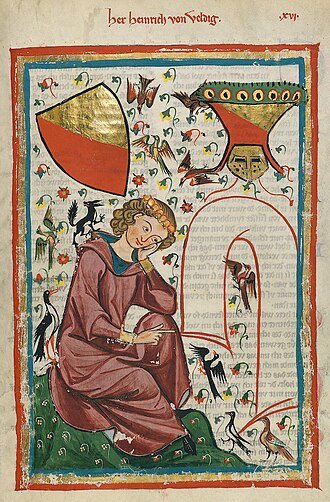
Hendrik van Veldeke
–1184 · Middle Dutch poet, pioneer of courtly romance in a vernacular language
Heinrich von Veldeke, known in Dutch as Hendrik van Veldeke, was a poet writing in Middle Dutch in the Limburg region during the second half of the twelfth century. He is the first writer from the Low Countries known by name who wrote in a European language other than Latin. Because his work belongs to both Dutch and German traditions, scholars in each country still argue over which form of his name to use.
He was born before or around 1150 in a hamlet called Veldeke, now part of Spalbeek near Hasselt in Belgian Limburg. His family probably belonged to the ministerial class, a group of unfree nobles who served lords. His use of Latin sources suggests that he received a thorough education. The exact dates of his life are uncertain, but he certainly died after 1184, since his Eneit refers to the court assembly that Emperor Frederick Barbarossa held at Mainz that year.
His first known work was the Life of Saint Servatius, probably written around 1170 in Middle Dutch for the canons of Maastricht. His most ambitious work followed. The Eneit is loosely based on the Old French Roman d'Énéas, which itself drew on Virgil's Aeneid. Most of it was written around 1175. Rather than translating closely, Veldeke shaped the story around courtly love, courtly virtues and an optimistic outlook, even in the face of tragedy. The poem survives only in Middle High German versions, which has led to debate about what Veldeke originally wrote in his own dialect. He is also credited with some thirty surviving love lyrics, notable for their humour and irony.
His legacy is twofold. In the Low Countries he is remembered as one of the first writers in the vernacular. In Germany the Eneit is often regarded as the first courtly romance in German literature, and his influence reached the Minnesang and later poets such as Wolfram von Eschenbach, who mentions Veldeke's early death in Parzival.
Key works
- Eneit (c. 1175): a courtly adaptation of the story of Aeneas that turns the classical epic into a romance of courtly love and chivalric virtue.
- The Life of Saint Servatius (c. 1170): a biography of the patron saint of Maastricht, written in Middle Dutch and considered one of the earliest literary works in that language.
- Lyric poems (12th century): around thirty surviving love poems, known for their humour, irony and playful use of sound.
Curiosities
A stolen manuscript
According to the poem's epilogue, the countess of Cleves lent the unfinished *Eneit* to one of her ladies, and it was stolen. Landgrave Herman of Thuringia returned it to Veldeke in 1184 and asked him to complete it. The identity of the thief remains unknown.
A disputed name
Scholars cannot agree on his name. Dutch scholars prefer Hendrik van Veldeke and German scholars Heinrich von Veldeke. The name of his birthplace, Veldeke, is sometimes used to avoid taking sides.
Original Filopedia text based on Wikipedia (es) and Wikipedia (en) and Wikidata.