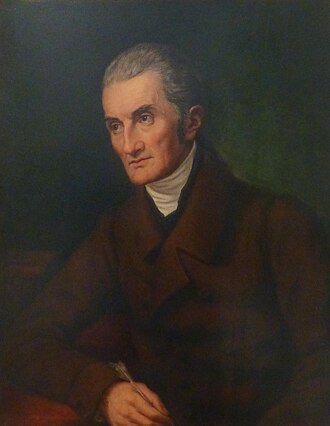
Heinrich Eberhard Gottlob Paulus (Leonberg, 1761 – Heidelberg, 1851; some sources give 1852) was a German theologian and one of the figures of the historical Jesus quest, which began with Hermann Samuel Reimarus. He matters because he tried to read the Gospels as human accounts that reason could explain.
He taught theology and oriental languages at Jena and later at Würzburg, and ended his career at Heidelberg, where he taught exegesis and church history. There he helped bring Hegel to the university in 1816, and his rationalism left a mark on Hegel's own theology.
In his Commentary on the First Three Gospels (1828), he argued that the miracles had natural explanations: some were optical illusions, others misunderstandings by those who witnessed them. For the resurrection, he suggested that Jesus had fallen into a cataleptic state after the spear thrust and had never truly died on the cross.
His rationalism soon fell out of favour with the rise of David Strauss's mythical reading of scripture. Today he is remembered as a forerunner of historical biblical criticism, though his swoon theory is widely criticised.
Key ideas
- Biblical rationalism. The miracles of the New Testament can be explained by natural causes or by misunderstanding.
- Natural explanation. What others saw as wonders were, in his view, ordinary events misread by eyewitnesses.
- Jesus as healer. Jesus was a healer whose deeds grew more marvellous in later retelling.
- Swoon theory. The resurrection was really a survival of crucifixion, not a supernatural event.
- Autonomy of reason. He held that individuals could examine religious texts freely, independent of church dogma.
Curiosities
Hegel in Heidelberg
Paulus was instrumental in hiring Hegel at Heidelberg in 1816. His rationalism shaped aspects of the philosopher's own theology.
The swoon theory
He is regarded as the first to propose that Jesus did not die on the cross but survived his execution.
Walking on water
In his explanation, the disciples thought they were in the middle of the Sea of Galilee, when in fact they were still in shallow water.
Original Filopedia text based on Wikipedia (es) and Wikipedia (en) and Wikidata.