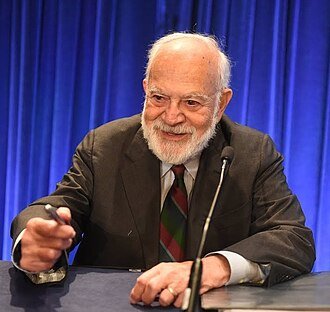
Harry Frankfurt
1929–2023 · American philosopher specializing in ethics and philosophy of mind
Harry Gordon Frankfurt (Langhorne, 1929 – Santa Monica, 2023) was an American philosopher and professor emeritus at Princeton University. He is best known for his compatibilist account of freedom and moral responsibility, and for a short essay on bullshit that became an unexpected bestseller.
Born at a home for unwed mothers, he was adopted shortly afterwards by a middle-class Jewish family. He earned his PhD in philosophy at Johns Hopkins in 1954 and taught at Ohio State, Rockefeller, Yale and Princeton. Early in his career he was known mainly for his readings of Cartesian rationalism, but his most influential work concerns the will. He argued that what makes someone a person is having second-order volitions: caring about which desires they want to act on. To show that someone can be responsible even when they could not have done otherwise, he devised the so-called Frankfurt cases, thought experiments that challenge the principle of alternative possibilities.
His 1986 essay "On Bullshit" was republished as a book in 2005 and became a bestseller. It separates lying, which requires knowing the truth, from bullshitting, which ignores whether what is said is true at all. A companion volume, "On Truth", followed in 2006. His influence extends across analytic ethics and the debate on free will.
Key ideas
- Second-order volitions: a person does not merely desire, but commits to the desires they want to have.
- Compatibilism: freedom consists in acting in line with one's reflective will, even in a deterministic world.
- Frankfurt cases: moral responsibility can hold even when there was no real alternative to acting otherwise.
- Bullshit: unlike lying, it speaks without regard for whether what is said is true.
- Caring and importance: caring about something is what makes it important to us.
Works in Filopedia
- On Bullshit 1986
Curiosities
An essay turned bestseller
His short 1986 essay on bullshit was republished as a book in 2005 and unexpectedly became a bestseller. It led to appearances on television programmes such as The Daily Show.
A pianist and a rabbi that never was
He was an amateur classical pianist who took lessons throughout his life. He said that being a philosophy professor was acceptable to his mother, who had hoped he would become a rabbi or a concert pianist.
Teachers and influences
Influenced by
- Immanuel Kant 1724–1804
- René Descartes 1596–1650
- Ludwig Wittgenstein 1889–1951
Original Filopedia text based on Wikipedia (es) and Wikipedia (en) and Wikidata.