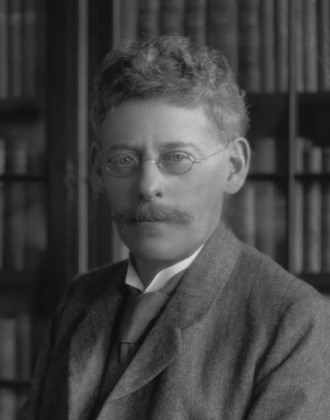
Harold Henry Joachim (London, 1868 – Oxford, 1938) was a British idealist philosopher and a disciple of Francis Herbert Bradley, whose posthumous papers he edited. He belongs to the later phase of the British idealist movement and is generally credited with the definitive statement of the coherence theory of truth in The Nature of Truth (1906). He was also a respected scholar of Aristotle and Spinoza.
Born in London to a wool merchant who had come to England from Hungary, he was educated at Harrow and Balliol College, Oxford, where he studied under R. L. Nettleship. After a prize fellowship at Merton College, he taught philosophy at the University of St Andrews before returning to Oxford, eventually becoming Wykeham Professor of Logic in 1919, succeeding the realist John Cook Wilson, a post he held until his death. His works include a study of Spinoza's ethics (1901), Immediate Experience and Mediation (1919) and Logical Studies (1948), together with commentaries on Aristotle.
For Joachim, a belief is true to the extent that it belongs to a system of judgments that hang together consistently. Bertrand Russell, who defended the correspondence theory, and William James, a pragmatist, both used his account as an example of what they considered mistaken in coherence theories. Today the coherence view is classed among so-called robust theories of truth. Among his Oxford students was the American poet T. S. Eliot.
Key ideas
- Coherence of truth: a proposition is true when it fits consistently within a larger system of judgments.
- Late idealism: reality is understood as an articulated whole, and knowledge means grasping its internal relations.
- Aristotle and Spinoza: his scholarship focused on the demonstrative structure of Spinoza's ethics and on Aristotle's account of change and coming-to-be.
- Critique of correspondence: truth cannot be reduced to a simple copy of external facts, since it depends on the relations among judgments.
Curiosities
Nephew of a famous violinist
He was the nephew of the violinist Joseph Joachim, and was himself a talented amateur violinist.
Teacher of T. S. Eliot
While at Oxford he taught the American poet T. S. Eliot.
Original Filopedia text based on Wikipedia (en) and Wikidata.