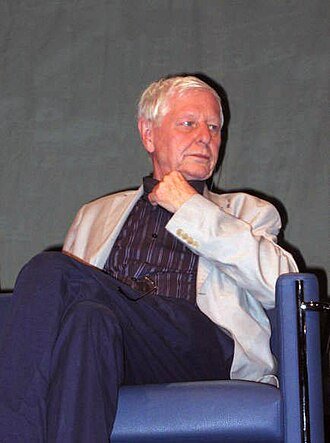
Hans Magnus Enzensberger
1929–2022 · German poet and essayist
Hans Magnus Enzensberger (Kaufbeuren, 1929 – Munich, 2022) was a German poet, essayist, novelist, playwright and translator, and one of the most influential writers in postwar Germany. Over more than six decades he moved between poetry, prose and public debate, becoming a central voice on politics, language and European society.
Born in 1929 in Kaufbeuren, Bavaria, he was the eldest of four brothers. His father worked as a telecommunications technician, and in 1931 the family moved to Nuremberg, where their next-door neighbour was Julius Streicher, publisher of the openly antisemitic newspaper Der Stürmer. As a teenager Enzensberger joined the Hitler Youth but was expelled soon afterwards, an episode he later described as a lifelong inability to fit into a group. After school he studied literature and philosophy in Erlangen, Freiburg, Hamburg and at the Sorbonne, and took his doctorate in 1955 with a thesis on the poetry of Clemens Brentano.
His literary career began in 1957 with the poetry collection Defense of the Wolves, followed by Country Tongue in 1960. Written in lower case and marked by irony and sarcasm, the poems were read as a challenge to the complacency of postwar German society. From 1965 to 1975 he was a member of Group 47, the circle of writers that helped reshape German literature and culture after the Nazi years. The group gave him a platform for a wide body of essays on politics, the media, ecology, migration and European integration. He founded and edited magazines such as Kursbuch and for years directed the book series Die Andere Bibliothek.
His interest in Spain and Latin America was constant. He first visited Spain in 1955 and returned often; he translated poets such as César Vallejo and Rafael Alberti, and devoted the novel The Short Summer of Anarchy to Buenaventura Durruti and the Spanish Civil War. He lived in Norway, Italy, the United States, Mexico and Cuba, and from 1979 settled in Munich, where he died in 2022 at the age of 93.
His legacy spans poetry, essays and popular writing for a broad public. His children's book The Number Devil has been translated into dozens of languages, and his essays on the 'consciousness industry' became a reference point for thinking about the mass media. He received the Georg Büchner Prize in 1963 and the Prince of Asturias Award for Communication and Humanities in 2002, among many other honours.
Key works
- Defense of the Wolves (1957): his first poetry collection, with sharp, critical verses about postwar Germany.
- The Short Summer of Anarchy (1972): a biographical novel about Buenaventura Durruti, a key figure of Spanish anarchism during the Civil War.
- The Sinking of the Titanic (1978): a verse comedy about the disaster and its symbolic meaning as a reflection on progress and catastrophe.
- The Number Devil (1997): an illustrated children's book that explains mathematics playfully to readers who fear it.
Where to start
The Number Devil 1997
It is the gentlest entry point to Enzensberger: a illustrated tale that introduces mathematics to readers who fear it. The reader will find a devil who visits a boy in his dreams and teaches him sequences, prime numbers and other ideas, with humour and without jargon.
Next: The Sinking of the Titanic. Once familiar with his lucid, playful style, The Sinking of the Titanic lets you explore his more critical and poetic side, on the failure of Western civilisation.
Works in Filopedia
Curiosities
Expelled from the Hitler Youth
As a teenager he joined the Hitler Youth but was expelled soon afterwards. He later said he had never been able to be a good comrade or stay in line.
Neighbour of Julius Streicher
His family moved to Nuremberg in 1931, and their next-door neighbour was Julius Streicher, founder of the antisemitic newspaper Der Stürmer.
Automatic poems at the World Cup
He helped invent and build a machine that composes poems automatically. It was used during the 2006 World Cup to commentate on matches.
Original Filopedia text based on Wikipedia (es) and Wikipedia (en) and Wikidata.