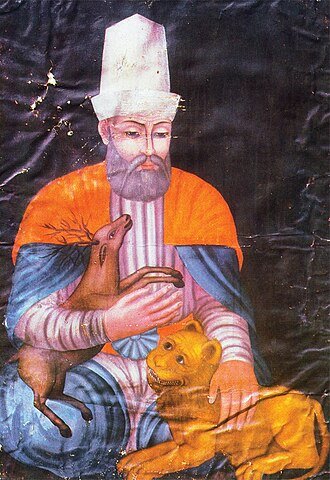
Haji Bektash Veli
1209–1271 · Sufi mystic and teacher from Khorasan, founder of the Bektashi order
Haji Bektash Veli (1209-1271) was a Sufi mystic from Khorasan who lived and taught in Anatolia under the Sultanate of Rum. He gave his name to the Bektashi order and is one of the most revered figures among the Alevis. He matters for his humanist outlook and for being one of the first authors to use Turkish as a literary language.
He was born in Nishapur, a major cultural centre in Khorasan later devastated by the Mongol invasions. According to the sources, he studied philosophy, physics and literature before travelling through Turkestan, Persia and Syria and making the pilgrimage to Mecca, which is the origin of the title haji. He settled in Anatolia, at Sulucakarahüyük, a place now named Hacıbektaş after him. Much of his life is shrouded in legend, and some of the genealogy attributed to him is hard to reconcile with the chronology. He wrote in Turkish in works such as Makalat and Feviad, and he is credited with a keen interest in the traditions of the Turkic clans.
His teaching combined an esoteric yet rational reading of Islam with tolerance and love for humanity, and it upheld the equality of women. During the Babai revolt his lodge remained open, a gesture that tradition links to the protection of many Alevis. He is believed to have been killed by the Seljuk rulers. His tomb at Hacıbektaş is now a pilgrimage site, and festivals honouring him are held every year on 14 and 15 August. The Bektashi order took shape after his death, became linked to the Janissary corps and spread into the Balkans.
Key ideas
- Humanism and tolerance: the central value is love for humanity above differences of belief.
- Esoteric yet rational Islam: faith is understood as an inner path that joins reason and spiritual experience.
- Equality of women: his precepts include the equality of men and women, unusual for his time.
- Turkish as a vehicle: he wrote in Turkish to reach the nomadic clans and give their tradition a voice.
Curiosities
An emerald mark
According to tradition, he bore an emerald-coloured mark on his hand and forehead, which served as proof of his lineage before other saints.
The Sultan of Hearts
He is also known as the Sultan of Hearts and the Dervish of the Dervishes, titles that reflect the veneration he inspired among his followers.
Teachers and influences
Influenced
- Yunus Emre 1241–1321
Original Filopedia text based on Wikipedia (es) and Wikipedia (en) and Wikidata.