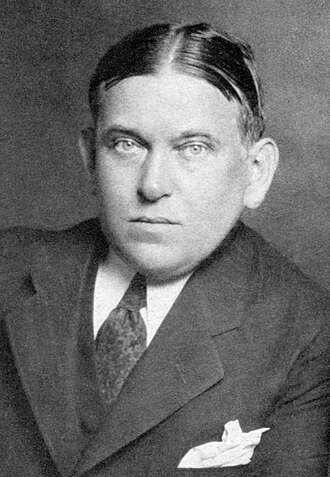
H. L. Mencken
1880–1956 · American journalist and essayist
H. L. Mencken (Baltimore, 1880–1956) was an American journalist, essayist, cultural critic and scholar of American English. He wrote during the rapid growth of the modern press, and his satirical voice made him one of the most debated figures in American intellectual life in the first decades of the twentieth century. His work, aimed at a broad readership, remains a useful guide to the culture of his time.
Born into a family of German descent, he grew up in the Union Square neighborhood of West Baltimore, where he would spend most of his life. By his own account his childhood was calm and uneventful. At nine he read Mark Twain’s Huckleberry Finn, which he later called the most stupendous event of his life, and he resolved to become a writer. He worked briefly in his father’s cigar factory before leaving to join the Baltimore Morning Herald as a reporter in 1899. In 1906 he moved to the Baltimore Sun, where his editorials and opinion pieces made his name. From 1908 he also worked as a literary critic for The Smart Set.
His style combined biting humor, blunt phrasing and a relish for controversy. An admirer of Nietzsche, he distrusted organized religion, representative democracy and fashionable ideas. He supported scientific progress and attacked Puritanism, Prohibition and Christian fundamentalism. He opposed American entry into both world wars. His writings also contain elitist and racist attitudes, and historians still debate how far these went. Some of his critics argue that he often wrote to provoke rather than from deep conviction.
In 1924 he founded The American Mercury with George Jean Nathan. The magazine reached a national readership and became highly influential on American campuses. He left its editorship in 1933. His scholarly study The American Language, on English as spoken in the United States, made him a recognized authority on the subject.
His private life was less public than he suggested. He presented himself as a contented bachelor, yet he had a long relationship with the writer and nurse Marion Bloom, and in 1930 he married the professor Sara Haardt, who died in 1935. In 1948 a stroke left him conscious but unable to read or write. He died in Baltimore in 1956.
His legacy lies in critical skepticism and in the idea that journalism can be both funny and combative. The character played by Gene Kelly in the film Inherit the Wind (1960) was inspired by him.
Key works
- The American Language, 1919: a study of the distinctive features of English as spoken in the United States.
- Prejudices, 1919–1927: a six-volume series of short, sharp essays on public and cultural life.
- The Philosophy of Friedrich Nietzsche, 1907: one of the early broad introductions to Nietzsche’s thought in English.
- Treatise on the Gods, 1930: an ironic examination of religion and its institutions.
- Happy Days, 1880–1892, 1940: a memoir of his childhood in Baltimore.
Books to read
- The American Language A Preliminary Inquiry into the Development of English in the United States EnglishGutenberg
- A Book of Burlesques EnglishGutenberg
- Prejudices, second series EnglishGutenberg
- The Philosophy of Friedrich Nietzsche EnglishGutenberg
- In Defense of Women EnglishGutenberg
- Prejudices, third series EnglishGutenberg
- Prejudices, first series EnglishGutenberg
- A Book of Prefaces EnglishGutenberg
- The American Credo A Contribution Toward the Interpretation of the National Mind EnglishGutenberg
Curiosities
A nickname that stuck
His satirical reporting on the Scopes trial brought him national attention. He himself dubbed it the “Monkey Trial,” a name by which the case is still remembered.
An unusual resolution
In 1931 the Arkansas legislature passed a motion to pray for his soul, after he had called the state the “apex of moronia.”
A surprising wedding
When he married Sara Haardt in 1930, many were surprised, since he had once called marriage “the end of hope.” He credited the decision to a hunch: “The Holy Spirit informed and inspired me.”
Teachers and influences
Influenced by
- Friedrich Nietzsche 1844–1900
- Mark Twain 1835–1910
- Rudyard Kipling 1865–1936
- Joseph Conrad 1857–1924
- Herbert Spencer 1820–1903
- Ambrose Bierce 1842–1914
Influenced
- Kurt Vonnegut 1922–2007
Original Filopedia text based on Wikipedia (es) and Wikipedia (en) and Wikidata.