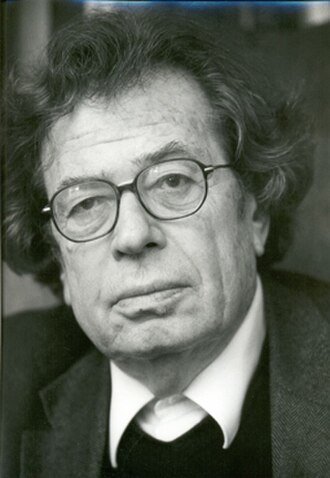
György Konrád
1933–2019 · Hungarian novelist, essayist and sociologist
György Konrád (Berettyóújfalu, near Debrecen, 1933 – Budapest, 2019) was a Hungarian novelist, essayist and sociologist who became known as a defender of individual freedom and independent thought. He wrote in Hungarian, and his work, shaped by the history of twentieth-century Central Europe, reached a wide readership at home and abroad during the communist years.
He was born into a prosperous Jewish family; his father ran a hardware business. The German occupation of Hungary in 1944 led to the deportation and death of many relatives, while he and his sister travelled to relatives in Budapest and survived. After the war he studied literature and sociology. In 1956 he took part in the Hungarian Uprising in the National Guard, an experience that shaped the rest of his career. For seven years he worked as a children's welfare supervisor in Budapest, and those experiences became the basis for his first major novel, The Case Worker, published in 1969 despite official criticism and quickly popular.
He also worked as a publisher's reader and editor, and later as a researcher of urban sociology, collaborating with Iván Szelényi. His novels, such as The City Builder, push language and form to new limits. His essays, notably Antipolitics, argued for a Central Europe with its own voice, independent of the Soviet bloc, and anticipated the end of the Iron Curtain. In 1973 he lost his job at the order of the political police, and after the publication of a study co-written with Szelényi he was arrested. Barred from publishing at home until 1989, he circulated his work through samizdat and Western publishers.
After the fall of the old regime he took an active part in public life and helped found the Alliance of Free Democrats. He served as president of PEN International from 1990 to 1993 and, from 1997 to 2003, as president of the Academy of Arts in Berlin, the first foreigner to hold that post. His legacy lies in his critical view of Central Europe, his role as a cultural bridge between East and West, and his memoir of childhood, Departure and Return.
Key works
- The Case Worker (A látogató, 1969): a novel drawn from the author's years as a social worker in Budapest.
- The City Builder (A városalapító, 1977): an experimental novel about urban life and power.
- Antipolitics (1983): essays on Central Europe and intellectual resistance to the totalitarian state.
- Departure and Return (Elutazás és hazatérés, 2001): an autobiographical account of his childhood during the Nazi occupation of Hungary.
Curiosities
A family that survived
Among the Jewish inhabitants of Berettyóújfalu, the Konrád family was the only one to survive the 1944 deportations intact. That experience later shaped his autobiographical novel about that year.
Sold out in days
Despite official criticism, his novel *The Case Worker* sold out within days of its 1969 publication.
Original Filopedia text based on Wikipedia (es) and Wikipedia (en) and Wikidata.