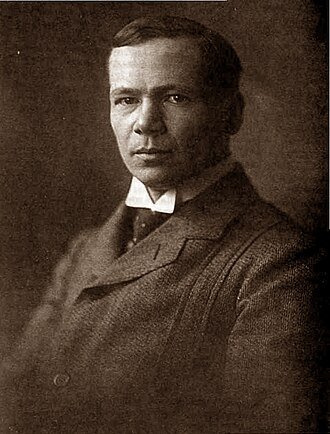
Gustav Shpet
1879–1937 · Russian philosopher, historian of philosophy and scholar of phenomenology
Gustav Shpet (1879-1937) was a Russian philosopher, historian of philosophy, psychologist, art theorist and interpreter of German and Polish descent, born in Kiev when the city belonged to the Russian Empire. He is best known for bringing Edmund Husserl's phenomenology to Russia, although he reshaped it in his own terms. He is said to have known seventeen languages, a skill that suited his work as an interpreter and translator.
The illegitimate son of an Austro-Hungarian officer and a mother from an aristocratic Polish-German background, he enrolled at St. Vladimir University in Kiev in 1898 and was expelled for joining a Marxist circle. He sympathised with the social and economic goals of Marxism but never adopted it as a philosophy. He studied under the psychologist Georgy Chelpanov and in 1921 founded the Institute of Scientific Philosophy in Moscow. He served as vice-president of the State Academy of Arts in Moscow from 1923 to 1929. His best-known books include A View on the History of Russian Philosophy, in two volumes, and The Hermeneutics and Its Problems.
His thought joined Husserl's analysis of the structure of consciousness to Orthodox Platonism, the doctrine of the Incarnation and a positive regard for matter. In the 1930s he was caught up in the Great Purge, sentenced to five years of internal exile in Tomsk and, after a second arrest in 1937, executed that November. He was posthumously rehabilitated in 1956. His espousal of phenomenology shaped literary scholars such as Mikhail Petrovsky, Grigory Vinokur and Mikhail Stolyarov.
Key ideas
- Adapted phenomenology: he started from Husserl's phenomenology but reinterpreted it from his own standpoint.
- History of Russian philosophy: he studied Russian thought as a tradition with its own character, in dialogue with religion.
- Hermeneutics: he examined how texts are interpreted and the meaning they carry.
- Incarnation and matter: he defended a positive view of matter, inspired by Russian religious thought.
Curiosities
A polyglot
He is said to have known seventeen languages, a detail that appears in the sources on his training.
Posthumous rehabilitation
Although he was executed in 1937, he was not rehabilitated until 1956.
Teachers and influences
Influenced
- Anna Akhmatova 1889–1966
Original Filopedia text based on Wikipedia (en) and Wikidata.