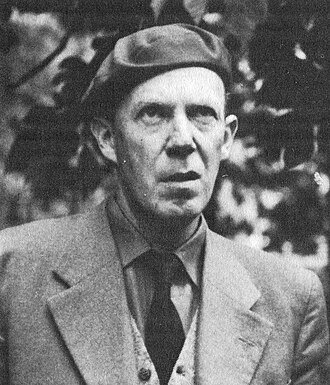
Gunnar Ekelöf
1907–1968 · Swedish poet and writer
Gunnar Ekelöf (Stockholm, 1907 – Sigtuna, 1968) was a Swedish poet and writer who worked in Swedish and also wrote in English. He is often described as one of Sweden's first surrealist poets, although his work also draws on European modernism and on Eastern poetry. He was elected to the Swedish Academy in 1958, and he remains a central figure in modern Swedish poetry.
He was born into a well-off family but grew apart from it early on. His father suffered from mental illness, and his mother's remarriage left him with a lasting dislike of his stepfather. By his teens he was already a loner and a rebel, uneasy with what he saw as the hypocrisy of the upper and middle classes. His debut, Sent på jorden, written after a stay in Paris, was a defiant book of violent images, broken syntax and no capital letters. Dedikation moved closer to Romanticism. Färjesång (1941), influenced by T. S. Eliot and Eastern poetry, found a plainer voice, which Ekelöf himself regarded as his real breakthrough. Non serviam (1945), whose title borrows Lucifer's motto, rejected conformity in the welfare society. In Strountes he played with nonsense to show that meaning can emerge from it, and in En Mölna-elegi he explored memory in a Proustian manner, with allusions to Swedenborg, Bellman and Strindberg.
His final works, a group of poems with a Byzantine theme, grew out of a journey to Istanbul and İzmir in 1965. They include Diwan över Fursten av Emgión, for which he received the Nordic Council Literature Prize in 1966. He died in Sigtuna in 1968. His influence endures in later Swedish poetry, which returned to the directness of Färjesång and the formal freedom of his early books.
Key works
- Sent på jorden (1932): his debut, a book of violent images and broken syntax written during a period of dark mood and literary revolt.
- Färjesång (1941): «Ferry Song», which he regarded as his real breakthrough, with plain language and a sombre tone.
- Non serviam (1945): a book of refusal to conform, its title taken from Lucifer's motto.
- Diwan över Fursten av Emgión (1965): a sequence about a fictional prince captured after the Battle of Manzikert, for which he won the Nordic Council Literature Prize.
Where to start
Non Serviam 1945
Non serviam is a good gateway into Ekelöf: a 1945 collection whose title borrows the Christian formula of Lucifer's refusal, «I will not serve». Readers will find a critique of the political and spiritual climate of Sweden at the time, written in a direct, defiant voice, and will grasp early on the tension between the individual and collective ideologies that runs through much of his work.
Next: Diwan on the Prince of Emgion. Diwan of the Prince of Emgión, from 1965, is a good next step, as it takes his search into a more complex form built on reinterpreting Byzantine songs and myths.
Works in Filopedia
- Non Serviam 1945
- Diwan on the Prince of Emgion 1965
Curiosities
A Nordic prize
For *Diwan över Fursten av Emgión* he received the Nordic Council Literature Prize in 1966, one of the most important awards in Scandinavian literature.
Ashes in Turkey
In accordance with his will, his ashes were scattered in the Pactolus, now called the Sart, in Salihli, Turkey, a town he had admired on a visit in 1965.
The river of Midas
According to the tradition recorded by Ovid, King Midas lost his golden touch by washing in that same river.
Original Filopedia text based on Wikipedia (es) and Wikipedia (en) and Wikidata.