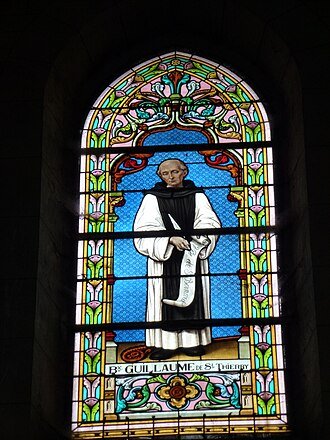
William of St-Thierry
1075–1148 · Benedictine and Cistercian theologian and mystic
William of Saint-Thierry was a theologian and mystic who moved from the Benedictine life to the Cistercian. Born in Liège around 1075, though some sources place his birth closer to 1085, he became abbot of Saint-Thierry, near Reims, before retiring to Signy, where he died in 1148. His friendship with Bernard of Clairvaux shaped his life: he wished to join the Cistercians, but Bernard dissuaded him while he remained at the head of his abbey.
He wrote in Latin between 1121 and 1148, and his thought centres on the experience of God. In On the Nature and Dignity of Love he argues that the relationship between human beings and God is essentially one of love, and that love and reason must illuminate each other. In his Meditations and in the Golden Epistle he describes a mystical path by which the soul, through remembrance, awareness and love, can return to its divine origin even during earthly life. He sought to reconcile Eastern and Western traditions, drawing on Augustine, Origen and Plotinus.
He also opposed Peter Abelard, whom he accused of holding heretical propositions; his denunciations helped lead to Abelard's condemnation at the Council of Sens. His influence reached later medieval spirituality.
Key ideas
- Love and reason: love must illuminate reason, and reason, in turn, must instruct love.
- Love as the path to God: God's love for humanity appears in Christ's passion and in the work of the Spirit, which unites the believer with God.
- Mystical return: the soul can return to its divine origin already in this life, through progressive stages of liberation.
- A synthesis of traditions: a theology that joins Eastern and Western mysticism.
Curiosities
A postponed vocation
He wished to take vows at Clairvaux as a Cistercian, but Bernard refused because William had duties as abbot of Saint-Thierry. He did not resign his abbacy until 1135.
Works attributed to Bernard
Three of his writings were widely read in the later Middle Ages and were often attributed to Bernard of Clairvaux. His authorship was only properly recognised in the early twentieth century.
Original Filopedia text based on Wikipedia (es) and Wikipedia (en) and Wikidata.