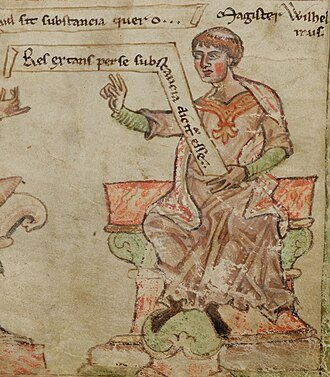
William of Conches
1080–1154 · Platonist grammarian and philosopher of Norman-French origin
William of Conches was a medieval grammarian and philosopher of the Platonist tradition, born in Normandy around 1080 or 1090 and dead around 1145 to 1154. He belonged to the School of Chartres, a group of twelfth-century scholars who tried to reconcile Christian morality and inherited learning with Plato's philosophy. The Chartrians were known for their interest in grammar, the arts of the quadrivium and the natural sciences.
He studied under Bernard of Chartres and taught in Chartres and Paris. Among his students was John of Salisbury, who regarded him as the most accomplished grammarian of his age. After his teachings on the Trinity were attacked, he withdrew from public instruction and devoted himself mainly to writing. He glossed works by Macrobius, Boethius, Priscian and Plato's Timaeus, and he also spread knowledge of Greek and Arabic medical and natural writings, often through the Latin translations of Constantine the African.
His best-known work, the Philosophy of the World, circulated for centuries under other authors' names. In it, God acts directly in some cases and in others through nature, understood as an instrument of divine operation. He also tutored the future Henry II of England in Anjou during the 1140s. His influence passed to later members of the school and shaped the medieval reception of natural science.
Key ideas
- True understanding: philosophy is defined as the genuine comprehension of things.
- Divine action and nature: God works either directly or through nature, seen as the instrument of his operation.
- Allegorical reading: apparently heretical passages in ancient authors conceal an orthodox truth.
- Cosmology and elements: the world is explained through four elements, defined by heat, cold, moisture and dryness.
Works in Filopedia
Curiosities
A work with many names
His Philosophy of the World was attributed for centuries to Bede, William of Hirsau, Honorius of Autun and Hugh of Saint Victor.
Tutor of a future king
He taught Henry, son of Geoffrey of Anjou, who later reigned in England as Henry II.
Teachers and influences
Pupils
- John of Salisbury 1110–1180
Original Filopedia text based on Wikipedia (es) and Wikipedia (en) and Wikidata.