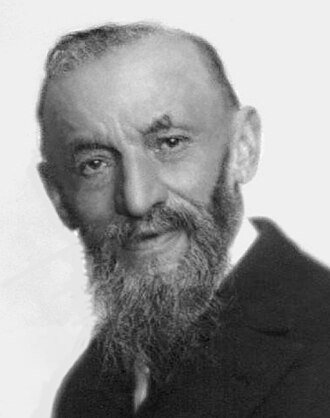
Giuseppe Peano
1858–1932 · Italian mathematician and logician, creator of the axiomatization of natural numbers
Giuseppe Peano (Spinetta, 1858 - Turin, 1932) was an Italian mathematician, logician and philosopher whose work shaped modern mathematical logic and the foundations of arithmetic. He published more than two hundred books and papers, most of them on mathematics, and is remembered for giving mathematics a symbolic language and an axiomatic rigour that remain in use today.
Born on a farm near Spinetta in Piedmont, he studied at the University of Turin, graduating in 1880 with honours. He began as an assistant to Enrico D'Ovidio and then to Angelo Genocchi, the professor of calculus. When Genocchi's health declined, Peano took over the teaching of the course within a few years. His first major work, a calculus textbook published in 1884, was credited to Genocchi. A few years later he published his first book on mathematical logic, where the modern symbols for the union and intersection of sets appear for the first time. In 1889 he set out the axioms that bear his name, a formal basis for the natural numbers, and that same year he was named first-class professor at the Royal Military Academy. The following year he also received a full professorship at the University of Turin.
In 1890 he published the space-filling curve, a counterexample showing that a continuous curve cannot be confined to an arbitrarily small region. It is now regarded as an early example of a fractal. That year he also founded the journal Rivista di Matematica. In 1891 he began the Formulario Project, which aimed to gather all known mathematical formulae and theorems into a single encyclopedia written in a notation of his own invention. The fifth and final edition appeared in 1908 as Formulario mathematico, with some 4200 formulae and theorems. Its notation is its lasting legacy, although the book attracted little attention because much of its content was already outdated.
Peano attended the first International Congress of Mathematicians in Zurich in 1897. At the 1900 congress in Paris he met Bertrand Russell, who was so struck by his logical symbols that he went away to study his work closely. That same year he raised the question of how a mathematical definition should be correctly formed, a problem that occupied him for the rest of his life. His absorption in the Formulario led him to neglect the teaching of calculus, and in 1901 he was dismissed from the Royal Military Academy, though he kept his post in Turin.
Peano was also a committed supporter of international auxiliary languages. In 1903 he presented Latino sine flexione, a simplified Latin without irregular forms, and used it in much of his writing. After his mother died in 1910 he divided his time between teaching, school textbooks and promoting such languages. In 1925 he moved from the chair of infinitesimal calculus to that of complementary mathematics, a change made official in 1931. He continued teaching until the day before his death in Turin on 20 April 1932.
His influence is wide. Peano's axioms remain the usual way of presenting the arithmetic of natural numbers, and his work on mathematical induction and symbolic logic helped lay the foundations of much of modern logic.
Key ideas
- Peano axioms: a formulation of the natural numbers from a small set of basic postulates, including the principle of induction.
- Logical notation: the introduction of dedicated symbols for sets and logical operations, which made formal reasoning easier.
- Rigorous mathematical definitions: the view that every definition must be correctly formed and stated with precision.
- International auxiliary language: the conviction that mathematics and commerce would benefit from a simple common language, Latino sine flexione.
Curiosities
Freemasonry
He joined a Masonic lodge in Turin in 1885, although where he was initiated is not known.
A lecture in Latin
When presenting Latino sine flexione in 1908, he began speaking in Latin and introduced each simplification as he described it, ending in his new language.
Teachers and influences
Influenced
- Bertrand Russell 1872–1970
Original Filopedia text based on Wikipedia (es) and Wikipedia (en) and Wikidata.