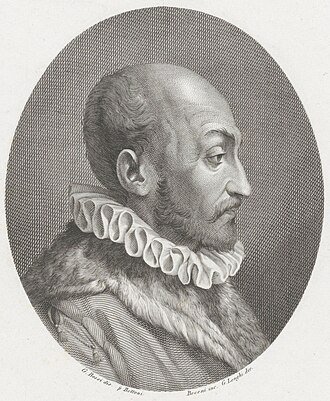
Giambattista della Porta
1535–1615 · natural philosopher, alchemist and playwright
Giambattista della Porta (Vico Equense, 1535 - Naples, 1615) was an Italian scholar whose life spanned the late Renaissance and the early years of the Scientific Revolution. He wrote mainly in Latin, the language of learning at the time, and is remembered as a popular writer on the secrets of nature as well as a playwright.
He was born near Naples into a noble family. His father, Nardo Antonio, raised his sons more as gentlemen than as scholars, teaching them dance, riding and courtly manners, yet he also filled the house with philosophers, mathematicians and poets. Della Porta received an informal education from tutors and visiting scholars. Between roughly 1563 and 1566 he travelled through Italy, France and Spain, gathering secrets and meeting learned men, and he presented his book on ciphers to Philip II of Spain.
His best-known work, Magia naturalis, covers astrology, alchemy, meteorology and natural philosophy. In 1563 he also described a digraphic substitution cipher, one of the earliest of its kind. His 1586 treatise on physiognomy later influenced Lavater and Lombroso. Around 1580 he founded the Academia Secretorum Naturae, one of the first scientific societies in Europe, which was forced to disband after its members were suspected of dealing with the occult. He saw his philosophical works banned from 1592 to 1598, yet remained a devout Catholic.
In later life he collected rare specimens and grew exotic plants, and he wrote Phytognomonica, which arranged plants by their geographical origin and recorded early observations of fungal spores. His plays, mostly comedies in the tradition of the learned commedia, remain performable. He helped spread knowledge of the camera obscura, though he did not invent it, and he is credited with an early telescope project he did not finish before his death. His legacy lies on the border between magic, experiment and modern science.
Key works
- Magia naturalis (1558; definitive edition, 1589): a compendium of knowledge about nature, from optics to astrology.
- De Furtivis Literarum Notis (1563): a treatise on cryptography, with digraphic and musical ciphers.
- De humana physiognomonia (1586): a study of the relationship between the face and character.
- Phytognomonica: a classification of plants by geographical origin, with early observations of spores.
Where to start
Natural Magic 1584
Magia Naturalis gathers recipes, experiments and explanations about nature, from plant cultivation to physical and optical phenomena. It is an accessible window into Renaissance experimental philosophy, offering concrete examples and curiosities that show how natural causes were sought before modern science.
Next: De Furtivis Literarum Notis. After the broad view of nature, De Furtivis Literarum Notis takes you into cryptography, a concrete field where della Porta refines the methods of his time.
Works in Filopedia
- De Furtivis Literarum Notis 1563
- Natural Magic 1584
Books to read
- The Pocket Lavater; or, The Science of Physiognomy To which is added an inquiry into the analogy existing between brute and human physiognomy EnglishEPUB 90 KBRead online
Curiosities
Messages in eggs
According to accounts of his work, della Porta devised a way to hide messages in an eggshell, using ink that soaked into the shell and could only be read after the egg was boiled and peeled.
Professor of secrets
He was known as the "professor of secrets", a nickname that reflected his interest in gathering and publishing hidden knowledge about nature.
Original Filopedia text based on Wikipedia (es) and Wikipedia (en) and Wikidata.