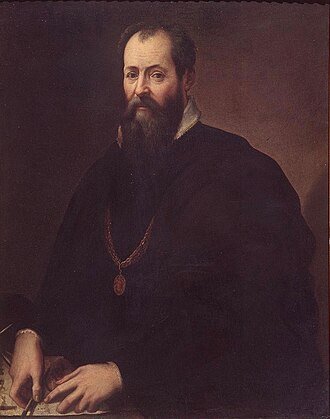
Giorgio Vasari
1511–1574 · Italian painter, architect and writer
Giorgio Vasari (Arezzo, 1511 – Florence, 1574) was an Italian painter, architect and writer of the late Renaissance, active in Florence under the Medici. He is remembered above all for a book, the Lives of the Italian artists, which made him one of the first art historians and which, according to a long-standing tradition, gave currency to the word Renaissance.
The son of a family from Arezzo, he first trained with a stained-glass painter, Guglielmo da Marsiglia, after a recommendation from his relative Luca Signorelli. At sixteen, Cardinal Silvio Passerini sent him to Florence, where he moved in the circle of Andrea del Sarto and came under the strong influence of Michelangelo's painting. In 1529 he went to Rome to study the work of Raphael and other artists of the previous generation. He was regularly employed by the Medici in Florence and Rome and also worked in Naples, Arezzo, Pisa, Bologna and Modena.
As a painter he belongs to Mannerism, a style that was more admired in his lifetime than later. His best-known work in this vein is the decoration of the Hall of the Five Hundred in the Palazzo Vecchio, commissioned in 1563, with scenes celebrating the victories of Cosimo I. As an architect, his chief work is the Uffizi palace, with its restrained, symmetrical classicism, and the Vasari Corridor, an elevated passage linking the Uffizi with the Pitti Palace across the Arno. He also remodelled the medieval churches of Santa Maria Novella and Santa Croce in the taste of his day.
His reputation brought him wealth and civic office in Arezzo, where he built a house and decorated it lavishly; it is now a museum. In 1563 he helped found the Accademia delle Arti del Disegno in Florence, with Michelangelo as its head.
The Lives appeared in 1550 and were expanded in 1568. Vasari presented art as the story of exceptional creators and gave the history of Italian art its first sustained narrative form. His accounts mix documented facts with anecdotes that may be true, exaggerated or invented. Modern scholarship has corrected many of his dates and attributions and has noted his clear preference for Florentine artists. Even so, the book remains a classic and a foundation for much of what we know about the Italian Renaissance.
Key works
- Lives of the Most Excellent Painters, Sculptors, and Architects (1550; expanded in 1568): the first great encyclopedia of artists' biographies, and the model for the modern writing of art history.
- The Uffizi Palace, Florence (begun 1560): a long building with a symmetrical façade, now one of Italy's most visited museums.
- The Vasari Corridor, Florence (1565): an elevated passageway linking the Palazzo Vecchio, the Uffizi and the Pitti Palace across the Arno.
- Hall of the Five Hundred, Palazzo Vecchio, Florence (1563-1565): painted decoration of the great hall, devoted to the deeds of Cosimo I de' Medici.
Books to read
- Lives of the Most Eminent Painters Sculptors and Architects, Vol. 01 (of 10) Cimabue to Agnolo Gaddi EnglishGutenberg
- Lives of the Most Eminent Painters Sculptors and Architects, Vol. 02 (of 10) Berna to Michelozzo Michelozzi EnglishGutenberg
- Lives of the Most Eminent Painters, Sculptors and Architects, Vol. 09 (of 10) Michelagnolo to the Flemings EnglishGutenberg
- Lives of the Most Eminent Painters Sculptors and Architects, Vol. 04 (of 10) Filippino Lippi to Domenico Puligo EnglishGutenberg
- Lives of the Most Eminent Painters Sculptors and Architects, Vol. 03 (of 10) Filarete and Simone to Mantegna EnglishGutenberg
- Lives of the most Eminent Painters Sculptors and Architects, Vol. 10 (of 10) Bronzino to Vasari, & General Index. EnglishGutenberg
- Lives of the Most Eminent Painters Sculptors and Architects, Vol. 05 (of 10) Andrea da Fiesole to Lorenzo Lotto EnglishGutenberg
- Lives of the most Eminent Painters Sculptors and Architects, Vol. 08 (of 10) Bastiano to Taddeo Zucchero EnglishGutenberg
- Lives of the most Eminent Painters Sculptors and Architects, Vol. 06 (of 10) Fra Giocondo to Niccolo Soggi EnglishGutenberg
- Vasari on technique : Being the introduction to the three arts of design, architecture, sculpture, and painting. Prefixed to the lives of the most excellent painters, sculptors and architects EnglishGutenberg
- Lives of the most Eminent Painters Sculptors and Architects, Vol. 07 (of 10) Tribolo to Il Sodoma EnglishGutenberg
Curiosities
Giotto's fly
Vasari tells how the young Giotto painted a fly on a picture by Cimabue, which the old master kept trying to brush away. It is probably fiction, although it echoes a story told about the Greek painter Apelles.
A word with a history
Vasari used the word rinascita in print. According to tradition, the French historian Jules Michelet adopted it in 1835 as Renaissance to name that cultural change.
Teachers and influences
Influenced
- Karel van Mander the Elder 1548–1606
Original Filopedia text based on Wikipedia (es) and Wikipedia (en) and Wikidata.