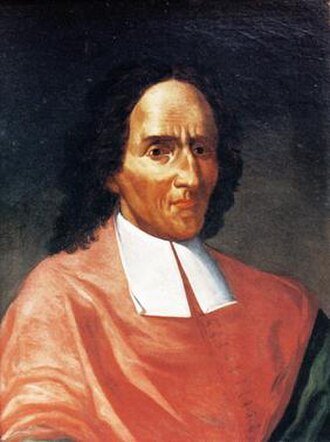
Giambattista Vico
1668–1744 · Neapolitan philosopher of history and jurist
Giambattista Vico (Naples, 1668-1744) was a lawyer, rhetorician and philosopher of history in the Kingdom of Naples. He is remembered above all for the idea that we can know with full certainty only what we ourselves make, and for proposing that the human sciences be studied together as a single discipline. He opposed the Cartesian rationalism of his age and is regarded as one of the first thinkers to question the ideal of a purely geometric reason.
The son of a bookseller, Vico was largely educated at home by tutors before studying law at the University of Naples. Between 1689 and 1695 he worked as tutor in the household of the Marquis of Rocca at Vatolla, where he had access to a large library that widened his reading. In 1699 he married and took a chair in rhetoric, a post he held for decades without ever gaining the more prestigious chair of jurisprudence he had hoped for. He supplemented his modest salary with private lessons, and in 1734 Charles III appointed him royal historiographer, at a salary higher than his professorial pay.
His works include the inaugural address De nostri temporis studiorum ratione (1708), De antiquissima Italorum sapientia (1710) and De rebus gestis Antonii Caraphaei (1716). His main work, the Principles of a New Science, appeared in 1725 and was revised in 1730 and 1744, the year of his death. In it he argues for the principle that the true and the made are convertible: God knows the world because He creates it, while humans can truly know only mathematics and history, which are their own constructions. For Vico history follows a providential order through three successive ages: the divine and theocratic, the heroic, marked by violence, and the human, reasonable and moderate. These cycles do not close like a perfect circle, however; they advance like a spiral, so that peoples are reborn and give rise to new forms.
His influence grew slowly. In the eighteenth century he was little read beyond Naples, but in the nineteenth French Romantic historians took him as a guide, and his ideas reached thinkers such as Montesquieu, Comte and Marx. In the twentieth century Benedetto Croce, Isaiah Berlin, Hayden White and Jorge Luis Borges, among others, revived his thought, and he is now recognised as a precursor of the philosophy of history and of semiotics.
Key ideas
- The true and the made: we know with certainty only what we are able to produce, such as history and mathematics.
- Providence and three ages: human history follows a providential order through the divine, heroic and human ages.
- Recurrence as a spiral: societies do not repeat their cycles identically but advance by creating new elements.
- Critique of rationalism: geometric reason is not enough for civic affairs, where prudence, rhetoric and common sense matter.
Works in Filopedia
Curiosities
A childhood fall
At the age of seven he had an accidental fall that kept him out of school for three years. His later education was probably largely self-directed, under his father's influence.
A marriage of childhood friends
In 1699 he married Teresa Caterina Destito, a childhood friend.
Royal historiographer
In 1734 Charles III appointed him royal historiographer, at a salary higher than he had earned as a university professor.
Teachers and influences
Influenced
- James Joyce 1882–1941
- Oswald Spengler 1880–1936
- Benedetto Croce 1866–1952
- Julius Evola 1898–1974
Original Filopedia text based on Wikipedia (es) and Wikipedia (en) and Wikidata.