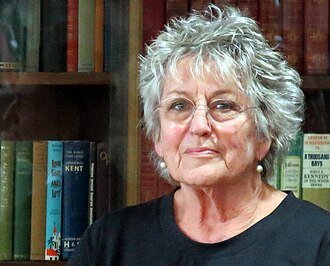
Germaine Greer
b. 1939 · Australian writer, academic and journalist
Germaine Greer (born Melbourne, 1939) became one of the most visible voices of second-wave feminism in the second half of the twentieth century. She wrote in English, trained as a specialist in English literature, and built a reputation far beyond the university through essays, literary criticism and newspaper columns.
She was born in Melbourne into a Catholic family and studied at a convent school before entering the University of Melbourne, where she graduated in 1959. That same year she moved to Sydney and became involved with the Sydney Push, a circle of anarchist intellectuals whose libertarian ideas, she later said, gave shape to beliefs she already held. In Sydney she took a master's degree with a thesis on Byron. In 1964 a scholarship took her to Cambridge, where she completed a doctorate on Shakespeare's early comedies. She settled mainly in England, teaching at the University of Warwick and at Newnham College, and held a shorter academic post in the United States.
She came to wide attention with The Female Eunuch (1970), a book that treated femininity as a social script imposed on women to satisfy male expectations. Greer rejected equality with men as a goal, which she saw as a form of assimilation, and argued instead for a liberation in which women defined their own values and futures. That stance placed her among radical feminists and made her a lightning rod from the start. Her later books covered literature, menopause, ageing, sexuality and, in her later years, the environment. For decades she wrote columns for British newspapers and spoke frankly about her own experiences of abortion, infertility and rape.
Her private life also drew public attention. A controversial dispute at Newnham College in the late 1990s made headlines, and in 2000 she was attacked in her home by a young woman who had been writing to her for months; the attacker was convicted. Greer took part in debates on gender identity, ageing and Australia's treatment of Indigenous peoples, often taking positions that divided her readers.
Her legacy lies in bringing to a general audience a feminism that questioned the foundations of gender, not just laws. For many readers she remains an uncomfortable and stimulating figure; for critics, some of her views have aged badly. Either way, her influence on public conversation about bodies, sex and female identity remains considerable.
Key works
- The Female Eunuch (1970), her most influential book, which analyses femininity as a social construct.
- Sex and Destiny (1984), an essay on female sexuality and women's place in modern society.
- The Change (1991), a reflection on menopause and women's ageing.
- The Whole Woman (1999), which revisits and revises her ideas on liberation and difference.
- The Madwoman's Underclothes (1986), a collection of essays and occasional writings.
Works in Filopedia
- The Female Eunuch 1970
Curiosities
A university nickname
During her years at the University of Melbourne she was nicknamed Germaine Queer, a reference to her open-minded views on homosexuality.
A brief marriage
In 1968 she married the Australian journalist Paul du Feu, but the marriage lasted only three weeks and ended in divorce in 1973.
Teachers and influences
Influenced by
- Simone de Beauvoir 1908–1986
- Mary Wollstonecraft 1759–1797
Original Filopedia text based on Wikipedia (es) and Wikipedia (en) and Wikidata.