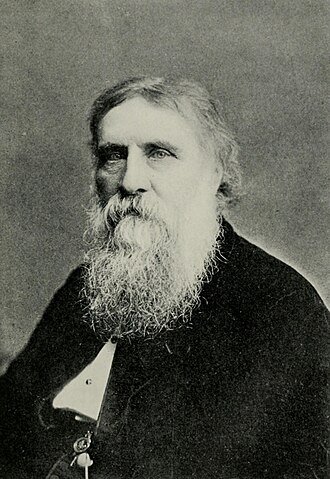
George MacDonald
1824–1905 · Scottish writer, poet and Congregational minister, pioneer of modern fantasy
George MacDonald (Huntly, 1824 – Ashtead, 1905) was a Scottish writer, poet and Congregational minister. Though less known today than he deserves, he is regarded as one of the pioneers of modern fantasy literature. His fairy tales and fantasy novels inspired J. R. R. Tolkien, W. H. Auden, C. S. Lewis and Madeleine L'Engle.
He was born in Huntly, in north-east Scotland, into a family of strong religious convictions with ties to the MacDonald clan. His mother had received a classical education, and one of her brothers was a Celtic scholar, so the household was unusually bookish. He grew up in the Calvinist tradition but never felt at ease with the doctrine of predestination. He studied at the University of Aberdeen and then trained for the ministry at Highbury College in London.
In 1850 he became pastor of the Congregational church in Arundel, but his sermons on God's universal love were poorly received, and his salary was halved. He later worked in Manchester, where ill health forced him to stop. Lung problems ran in his family, so he sought purer air, spending time in Algiers before settling in London, where he taught at the University of London. He also edited Good Words for the Young.
His work moves between fantasy and realism. Phantastes (1858), The Princess and the Goblin (1872), At the Back of the North Wind (1871) and Lilith (1895) are his best-known fantasy books, alongside tales such as 'The Light Princess' and 'The Golden Key'. He also wrote realist Scottish novels such as Alec Forbes, among the first of their kind in the country and precursors of the so-called kailyard school. He published volumes of sermons too. He used fantasy to explore the human condition, and said he wrote not for children but for the childlike, whether five or seventy-five.
His theology leaned towards universalism: he held that, in the end, everyone would repent and return to God. This is closer to Gregory of Nyssa than to the idea that all are saved automatically. He also rejected aspects of Calvinism that he found unjust.
From 1879 he lived with his family in Bordighera, on the Ligurian Riviera, where he spent about twenty years and wrote much of his work. There he founded Casa Coraggio, a cultural centre that drew many visitors. He mentored Lewis Carroll, whose Alice was encouraged by MacDonald's advice. He died in Ashtead in 1905. His influence reaches C. S. Lewis, who called him his 'master' and made him a character in The Great Divorce.
Key ideas
- Universalism: the conviction that God loves everyone and that, in time, all people will return to him.
- Fantasy as a way of seeing: fairy tales allow an exploration of the human and the spiritual with a freedom realism does not permit.
- Opposition to predestination: rejection of the idea that God's love is reserved for some and denied to others.
- The childlike sensibility: the capacity for wonder does not disappear with age, and literature can address it at any stage of life.
Where to start
The Princess and the Goblin 1872
The Princess and the Goblins is an accessible children's fantasy with a brave princess, a miner's boy named Curdie and goblins living beneath the mountain. It is the ideal entry point to MacDonald, combining adventure, humour and a deep moral and spiritual insight without requiring any prior background.
Next: At the Back of the North Wind. At the Back of the North Wind expands his imaginative world with a tender, mysterious story about the wind, childhood and death, making it a natural next step after the first reading.
Works in Filopedia
- Phantastes 1858
- The Gray Wolf 1864
- At the Back of the North Wind 1871
- The Princess and the Goblin 1872
- Lilith: A Romance 1895
Books to read
- The Princess and the Goblin EnglishEPUB 186 KBRead online
- Phantastes: A Faerie Romance for Men and Women EnglishEPUB 250 KBRead online
- At the Back of the North Wind EnglishEPUB 262 KBRead online
- Lilith: A Romance EnglishEPUB 281 KBRead online
- The Light Princess EnglishEPUB 105 KBRead online
- Unspoken Sermons, Series I., II., and III. EnglishEPUB 435 KBRead online
- The Princess and Curdie EnglishEPUB 191 KBRead online
- Sir Gibbie EnglishEPUB 598 KBRead online
- A Dish of Orts : Chiefly Papers on the Imagination, and on Shakespeare EnglishEPUB 273 KBRead online
- Robert Falconer EnglishEPUB 594 KBRead online
- Ranald Bannerman's Boyhood EnglishEPUB 234 KBRead online
- A Book of Strife in the Form of The Diary of an Old Soul EnglishEPUB 127 KBRead online
- At the Back of the North Wind EnglishGutenberg
Curiosities
A journey that changed Lewis
C. S. Lewis recounted that he began reading Phantastes by chance at a railway station and that, a few hours later, he felt he had crossed a great frontier.
Tears over predestination
According to a legend, when the doctrine of predestination was first explained to him he burst into tears, although he insisted that he was one of the elect.
A photographer among his children
Lewis Carroll, one of the great Victorian photographers, took portraits of several of MacDonald's children, with whom he had formed a friendship.
Teachers and influences
Influenced
- J. R. R. Tolkien 1892–1973
- C. S. Lewis 1898–1963
- W. H. Auden 1907–1973
Original Filopedia text based on Wikipedia (es) and Wikipedia (en) and Wikidata.