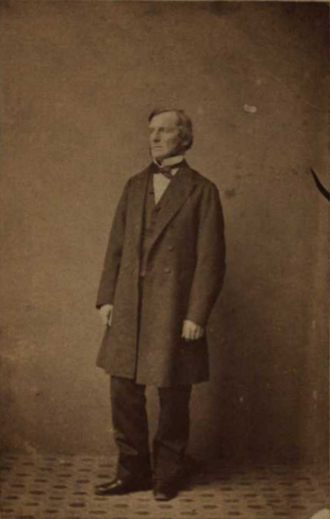
George Boole
1815–1864 · British mathematician and logician
Early years in Lincoln
George Boole was born on 2 November 1815 in Lincoln, Lincolnshire, England, the son of John Boole, a shoemaker of modest means who was keenly interested in mathematics and logic, and of Mary Ann Joyce. His father gave him his first lessons in these subjects and taught him the basics of primary education. The young Boole's mathematical talent did not show itself at once; at first he was more drawn to the humanities.
A serious decline in the family business left him with little further formal schooling. Boole was largely self-taught in modern languages and learned Latin, perhaps with help from the bookseller William Brooke or at the school of Thomas Bainbridge. One story holds that a local newspaper printed his translation of a Latin poem, and that a scholar accused him of plagiarism, claiming the boy could not have achieved such a thing.
Teacher and first professional steps
At sixteen Boole became the main breadwinner for his parents and three younger siblings. He took a junior teaching post in Doncaster, at Heigham's School, and also taught briefly in Liverpool. While working he studied higher mathematics on his own. Edward Bromhead, who knew his father through the Lincoln Mechanics' Institute, helped him with mathematics books, and the Reverend George Stevens Dickson lent him the calculus text of Sylvestre François Lacroix. Without a teacher to guide him, it took him many years to master calculus.
At nineteen he founded his own school in Lincoln, Free School Lane. Four years later, after the death of Robert Hall, he took over Hall's Academy at Waddington, just outside Lincoln. In 1840 he returned to the city to run a boarding school.
Public life in Lincoln
Boole quickly became part of local life. He served on the committee of the Lincoln Topographical Society and presented a paper on the origin, progress and tendencies of polytheism, especially among the ancient Egyptians and Persians and in modern India. He became a prominent local figure and admired the bishop, John Kaye. He joined the local campaign for early closing of shops and, with Edmund Larken and others, set up a building society in 1847. He also had contact with the Chartist Thomas Cooper, whose wife was a relation.
From 1838 onwards he made contact with sympathetic British academic mathematicians and read more widely. He studied algebra in the form of symbolic methods, as these were understood at the time, and began to publish research papers.
Mathematical and logical publications
His first published work, on the theory of analytical transformations, appeared in 1839 in the Cambridge Mathematical Journal. He went on to publish many articles in that journal, in its successor, and in the Philosophical Magazine. In 1844 his paper "On a General Method in Analysis" won the Royal Society's first gold prize for mathematics. In 1841 he had also published an influential article on the emerging theory of invariants.
In 1847 he issued The Mathematical Analysis of Logic, the first presentation of his symbolic logic, which he himself regarded as a hasty and imperfect account. Its ideas matured in An Investigation of the Laws of Thought, on Which Are Founded the Mathematical Theories of Logic and Probabilities (1854). In this work he set out a symbolic method for logical inference: given premises, they can be treated symbolically to reach the conclusion they contain. The second part sought a general method for finding the probability of any event logically connected with events whose probabilities are known. That method provoked controversy in the Philosophical Magazine.
In 1857 he published On the Comparison of Transcendents, with Certain Applications to the Theory of Definite Integrals, which studied the sum of residues of a rational function and proved the identity that now bears his name. Its generalization plays an important role in the theory of the Hilbert transform. His main discoveries were gathered in two treatises: A Treatise on Differential Equations (1859), which developed the general symbolic method, and A Treatise on the Calculus of Finite Differences (1860). The first became a textbook at the University of Cambridge for decades.
Professor in Cork
In 1849 he was appointed the first professor of mathematics at Queen's College, Cork, in Ireland, today University College Cork. There in 1850 he met Mary Everest, niece of the Greek professor John Ryall; they married in 1855. He kept his ties with Lincoln and worked with E. R. Larken in a campaign to reduce prostitution. In 1861 a court judgement gave him the estate and interests of John Hewitt Wheatley in Maghan or Mahon, County Cork. In March 1863 he leased Litchfield Cottage in Cork, where he lived with his wife until his death.
His religious and social views were expressed in four published addresses: The Genius of Sir Isaac Newton (1835), The Right Use of Leisure (1847), The Claims of Science (1851) and The Social Aspect of Intellectual Culture.
Final years, death and family
Boole died on 8 December 1864 at Ballintemple, County Cork, of a fever that ended in a pleural effusion. In his will he left his wife all his property and his rights under the lease of the house. He was buried in the churchyard of St Michael's, in Blackrock, Cork.
The couple had five daughters. Among their descendants was the writer Ethel Lilian Voynich, author of the novel The Gadfly, along with several scientists. Boole was remembered for his modesty and his devotion to the pursuit of truth.
Legacy
Although Boole did not set out to create a theory of computing, his algebra is now the foundation of digital logic. Intellectual heirs such as Charles Sanders Peirce and William Stanley Jevons developed his ideas. Decades later Claude Shannon and Victor Shestakov applied Boolean algebra to the design of electromechanical relay circuits, a decisive step towards modern electronic computers. He received many honours, including the Keith Medal and honorary degrees from the universities of Dublin and Oxford. In 2015 University College Cork marked the bicentenary of his birth.
Key ideas
- Boolean algebra: a system of operations on two values, true and false, that allows reasoning to be manipulated as if it were algebra.
- Symbolic logic: propositions are represented by letters and logical connectives by operators, which makes systematic simplification possible.
- Logical probabilities: a general method for calculating the probability of events logically linked to others whose probabilities are known.
- Operational methods: in his work on differential equations he accepted that operations do not always commute.
Works in Filopedia
- The Laws of Thought 1854
Books to read
- The calculus of logic EnglishEPUB 126 KBRead online
- An Investigation of the Laws of Thought On which are founded the mathematical theories of logic and probabilities EnglishGutenberg
- The Mathematical Analysis of Logic Being an Essay Towards a Calculus of Deductive Reasoning EnglishGutenberg
Curiosities
An accusation of plagiarism
When a local newspaper printed his translation of a Latin poem, a scholar accused him of plagiarism, arguing that he was not capable of such an achievement.
A notable line of descent
His daughter Mary Ellen married the mathematician Charles Howard Hinton. Among her descendants is Geoffrey Hinton, who won the 2024 Nobel Prize in Physics.
A novelist in the family
His daughter Ethel Lilian wrote the novel The Gadfly and married the Polish scientist and revolutionary Wilfrid Michael Voynich.
Teachers and influences
Influenced
- Bertrand Russell 1872–1970
- Augustus De Morgan 1806–1871
Original Filopedia text based on Wikipedia (es) and Wikipedia (en) and Wikidata.