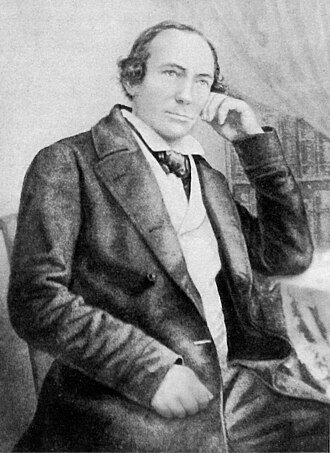
Georg Friedrich Daumer
1800–1875 · German poet and philosopher
Georg Friedrich Daumer (Nuremberg, 1800 – Würzburg, 1875) was a German poet and philosopher of the first half of the nineteenth century, active in the Kingdom of Bavaria. He is remembered above all for moving from orthodox Protestantism to a sharp critique of Christianity and, later, for his conversion to Catholicism, as well as for his poetry.
He attended the gymnasium of his native city, then directed by Hegel, and in 1817 enrolled at the University of Erlangen to study theology, though he soon turned to philosophy. For years he taught at the Nuremberg gymnasium until poor health led to a pension and he devoted himself entirely to literature. He was also a tutor to the enigmatic foundling Kaspar Hauser between 1828 and 1830, and wrote several works about that case.
His thought began in Pietism but grew sceptical and leaned towards pantheism. His writings of the 1830s and 1840s attacked Christianity from an anti-theological standpoint, and in Die Religion des Neuen Weltalters (1850) he proposed a new religion of love and peace. Marx and Engels answered it in a joint review for the Neue Rheinische Zeitung, objecting that he saw history as a struggle between coarseness and culture rather than between economic classes.
Around 1858 he publicly embraced Catholicism and became its zealous defender. His poetry has lasted best: his Hafis, free imitations of a Persian poet's songs, inspired Brahms's Liebeslieder waltzes. Today his significance is mainly literary and musical, though his religious writings remain a notable example of nineteenth-century criticism of Christianity.
Key ideas
- Pantheism: the divine is identified with the whole of nature, an idea that gained weight in his thought after his Pietist years.
- Anti-theological critique: orthodox Christianity and its asceticism were, in his view, the source of hypocrisy and had to be overcome.
- A new religion of peace and love: a proposal to replace Christianity, set out in Die Religion des Neuen Weltalters.
- Struggle between coarseness and culture: a view of history that, against Marx and Engels, placed the conflict in the cultural rather than the economic sphere.
Curiosities
Tutor to Kaspar Hauser
Between 1828 and 1830 he acted as mentor and teacher to the mysterious foundling Kaspar Hauser, and wrote several works about the case.
Brahms and the Persian imitations
Some poems from his Hafis, free imitations of songs by Hafiz, became widely known through Brahms's Liebeslieder.
Original Filopedia text based on Wikipedia (es) and Wikipedia (en) and Wikidata.