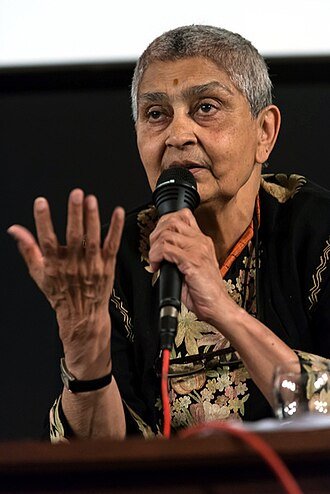
Gayatri Chakravorty Spivak
b. 1942 · Indian literary theorist and postcolonial critic
Gayatri Chakravorty Spivak (born in Calcutta in 1942) is an Indian literary theorist and philosopher, one of the most influential figures in postcolonial thought. Her work brings together Marxism, feminism and deconstruction around a single question: who is allowed to speak, and who is heard, in the stories the West tells about the rest of the world. She is best known for her essay "Can the Subaltern Speak?" and for her translation of Jacques Derrida's Of Grammatology.
Spivak came from a Bengali Brahmin family and graduated in English from Presidency College, Calcutta, in 1959. In 1961 she went to the United States to study at Cornell University, where she completed her master's degree in 1962. Her doctoral work on the Irish poet W. B. Yeats was supervised by Paul de Man. She taught at the universities of Iowa, Texas, Emory and Pittsburgh before joining Columbia University in 1991, where she has remained for much of her career.
Her translation of Derrida, with a translator's preface that readers have since used as an introduction to deconstruction, brought her wide attention. From there she turned to historical studies and literary criticism of imperialism from a feminist standpoint, working within the Subaltern Studies group. In "Can the Subaltern Speak?" she argues that the subaltern may be physically able to speak but has no place from which their voice is heard and taken seriously. Women, positioned as both gendered and colonised subjects, are in the most marginal place of all. The essay also introduced the notion of epistemic violence, the erasure of the meanings through which a people understands its everyday, legal and symbolic life, a term later taken up by decolonial scholars.
In A Critique of Postcolonial Reason (1999) she examines how major European thinkers such as Kant, Hegel and Marx not only leave the subaltern out of their discussions but make it hard for non-Europeans to be seen as fully human subjects. She also proposed strategic essentialism: the willingness to adopt, temporarily and deliberately, an essentialist position that allows diverse groups to act together effectively. Her dense, demanding prose has drawn criticism, but her influence on literary theory, gender studies and decolonial thought remains broad and continues to grow.
Key ideas
- Subalternity: oppressed and voiceless groups, such as women, peasants or tribal peoples, lack a place from which their speech is recognised.
- Epistemic violence: the alteration or erasure of the meanings through which a people makes sense of its everyday, legal and symbolic life, especially under colonialism.
- Strategic essentialism: the temporary adoption of a shared identity in order to achieve concrete goals in social action among diverse groups.
- Critique of Eurocentrism: the argument that European philosophy has excluded non-Europeans from full recognition as human subjects.
Curiosities
Translator of Derrida
She bought Of Grammatology in 1967 without being familiar with its author. She decided to translate it, and her translator's preface came to be used worldwide as an introduction to deconstruction.
Kyoto Prize
In 2012 she received the Kyoto Prize in Arts and Philosophy, and she directed most of the award money to a foundation for rural education among the Dalit people of western Bengal.
Original Filopedia text based on Wikipedia (es) and Wikipedia (en) and Wikidata.