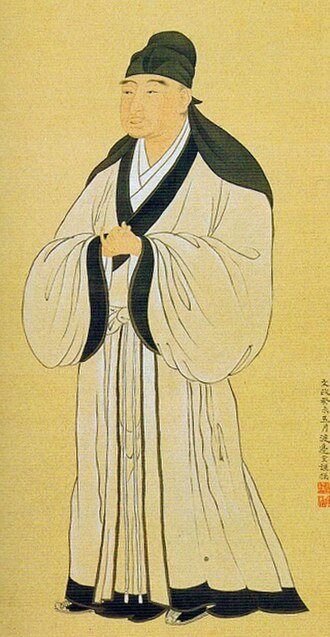
Fujiwara Seika
1561–1619 · Japanese Neo-Confucian philosopher and writer of the Edo period
Fujiwara Seika (1561-1619) was a Japanese Neo-Confucian philosopher and writer of the Edo period. He is generally regarded as one of the early promoters of Zhu Xi's teachings in Japan, at a time when Zen Buddhism dominated intellectual life. His significance lies in opening the way for Confucianism to be studied as a discipline in its own right rather than only as part of monastic training.
Born in Harima Province, in what is now Miki City in Hyogo Prefecture, on February 8, 1561, he belonged to the Reizei family. At around seven or eight he was sent to the Shokoku-ji temple to become a Zen priest, where he studied Confucianism alongside his Zen practice. In 1596 he tried to travel to Ming China to learn from an authentic Confucian master, but bad weather forced his party to turn back. He later learned more about Neo-Confucianism from the Korean scholar Kang Hang.
His thought centred on the idea that personal morality and social order rest on Confucian principles, and that studying the classics is the path to cultivating virtue. His influence spread mainly through his students, above all Hayashi Razan, who brought Neo-Confucianism to the Tokugawa shogunate court and made it a reference doctrine for government.
Key ideas
- Neo-Confucianism as an independent discipline: the study of the Confucian classics is presented as a path to moral formation, separate from religious practice.
- Harmony between the individual and society: personal virtue is understood as the foundation of social and political order.
- A synthesis of Zen and Confucianism: trained in Zen, he held that both traditions could coexist in the pursuit of wisdom.
Curiosities
A failed voyage to China
In 1596 he tried to travel to Ming China to study with an authentic Confucian master, but bad weather forced the expedition to turn back.
Training in a Zen temple
At around seven or eight he entered the Shokoku-ji temple to become a Zen priest, and there he studied Confucianism alongside Zen.
Teachers and influences
Pupils
- Hayashi Razan 1583–1657
Original Filopedia text based on Wikipedia (en) and Wikidata.