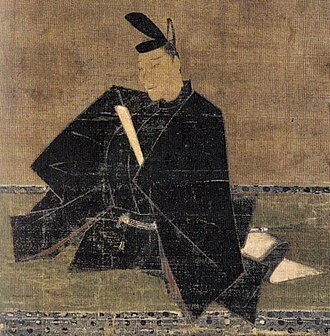
Fujiwara no Teika
1162–1241 · Japanese waka poet, critic, anthologist and calligrapher
Fujiwara no Teika (1162-1241) was a Japanese poet, critic, anthologist, calligrapher and scholar who worked between the late Heian and early Kamakura periods. He wrote in Japanese, and today he is counted among Japan's greatest poets and perhaps the foremost master of waka, a form of five lines with 31 syllables in total. His ideas on how to compose poetry were so influential that they were still being studied as late as the Meiji era.
He came from a minor and distant branch of the Fujiwara, the aristocratic clan that had lost its political dominance at court after the Hōgen Rebellion. His branch sought standing through the arts, above all poetry, a field where it could compete without challenging the senior line in politics. His father, Fujiwara no Shunzei, was a highly respected poet who had compiled an imperial anthology. Teika's life was marked by illness and sudden reversals of fortune, but the patronage of the retired emperor Go-Toba opened the doors of the court to him.
At first Go-Toba commissioned him to compile anthologies, and the relationship was cordial. Later, however, Teika was banished from the retired emperor's court. His descendants and his ideas nevertheless shaped classical Japanese poetry for centuries. Today he is remembered above all as a theorist of waka, as the author of the diary Meigetsuki, and as the compiler of the hundred-poem collection that bears his name.
Key works
- Hyakunin Isshu, an anthology of one hundred poems by various authors, best known as Teika's compilation.
- Meigetsuki, the diary in which he recorded his life and daily work as a court poet.
- Shoji hyakushu (1200), a sequence of one hundred poems written for the contest called by Go-Toba.
Works in Filopedia
Curiosities
A blow with a lamp in 1185
According to the sources, in 1185 he lost his temper and struck a lower-ranking general with a lamp. His father had to intervene once more to save his career.
A poem that opened the court's doors
Go-Toba's secretary, Minamoto no Ienaga, recorded that poem number 93 in the sequence won Teika the special permission needed to enter the retired emperor's court.
Teachers and influences
Influenced
- Yukio Mishima 1925–1970
Original Filopedia text based on Wikipedia (es) and Wikipedia (en) and Wikidata.