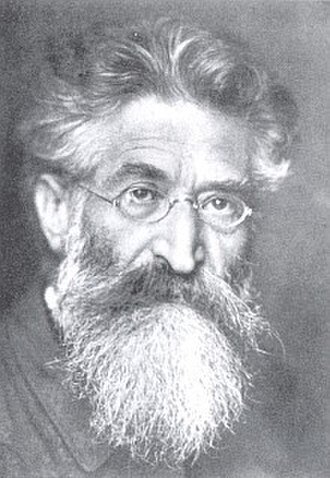
Fritz Mauthner
1849–1923 · Austrian philosopher and sceptic of language
Fritz Mauthner (born in Hořice, Bohemia, 1849; died in Meersburg, 1923) was a philosopher and writer in German, from an assimilated Jewish family. He is best known for his sceptical view of language, although he also wrote novels, parodies and theatre criticism.
In Prague he studied law and encountered the physicist Ernst Mach, whose ideas shaped his view of knowledge. In 1876 he settled in Berlin, where he worked as a journalist and published popular parodies and novels. Around 1892 he began his Contributions to a Critique of Language, which appeared between 1901 and 1902. The academic response was cool, and this rejection deeply disappointed him.
In 1905 he moved to Freiburg and later to Meersburg, on Lake Constance, where he completed his Dictionary of Philosophy (1910-1911) and the monograph Die Sprache. His final major project, Atheism and Its History in the Occident, came out in four volumes between 1920 and 1923, and expressed his wish that people would free themselves from the idea of God.
His thought starts from an evolutionary view of knowledge. Our five senses, which he called accidental senses, capture only part of reality, and knowledge serves practical aims rather than an objective grasp of the world. Language, useful for communication, is for him an arbitrary system of symbols and metaphors that cannot share sensory experience, only allude to it. He therefore concluded that many philosophical problems are, at bottom, problems of language.
His influence was considerable. Wittgenstein acknowledged his debt to Mauthner's ideas, Borges praised his Dictionary of Philosophy, and he is regarded as a forerunner of logical empiricism and analytic philosophy.
Key ideas
- Scepticism about language: language is a useful social tool, but it does not give us access to reality as it is.
- Accidental senses: our senses reveal only a limited part of the world.
- Problems of language: much of philosophy reduces to questions about language.
- Critique of metaphysics: only science describes reality, and metaphysics lacks a solid foundation.
Curiosities
An unusual gravestone
His gravestone in Meersburg reads Vom Menschsein erlöst, which can be translated as Redeemed from being human.
Adopted son of Meersburg
In 1919 he was named an honorary adopted son of Meersburg, the town on Lake Constance where he spent his last years.
Original Filopedia text based on Wikipedia (es) and Wikipedia (en) and Wikidata.