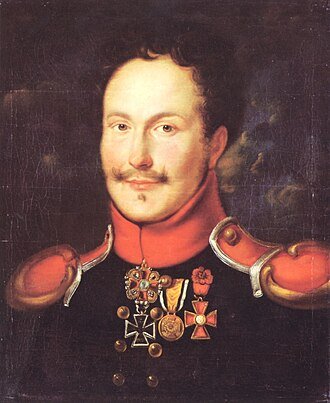
Friedrich de la Motte Fouqué
1777–1843 · German Romantic novelist and poet
Friedrich de la Motte Fouqué (Brandenburg, 1777 – Berlin, 1843) was a German writer of the Romantic movement. Today he is remembered mainly for Undine, although in his own time he was one of the most widely read authors in Prussia.
He came from a family of French Huguenot origin with a strong military tradition; his grandfather had served as a general under Frederick the Great. Fouqué began university studies at Halle but abandoned them to join the army, and he took part in the Rhine campaign of 1794. He then devoted himself fully to literature, encouraged by the critic August Wilhelm Schlegel, who published his first book, Dramatische Spiele von Pellegrin (1804).
His subsequent works revealed his Romantic leanings: poems on chivalric themes, a verse retelling of a medieval romance, and above all the drama Sigurd der Schlangentöter (1808), one of the first modern attempts to stage the Nibelung legend using Icelandic and medieval sources. This blend of knightly tradition and northern mythology shaped much of his output. In 1813 he fought against Napoleon once more, and the patriotic mood of those years found its way into his writing.
Between 1810 and 1815 his popularity reached its height, fuelled by a rapid stream of novels, plays and epic poems. His tale Undine, published around 1811, is the work that has best survived. From 1820 onward his output declined, as he clung to Romantic forms just as literary tastes were changing, and his rivals nicknamed him the “Don Quixote of Romanticism.”
He married three times. At the end of his life King Frederick William IV of Prussia granted him a pension that allowed him to live comfortably until his death in Berlin in 1843. His legacy is largely indirect: Undine inspired later writers of fantastic fiction and, together with a tale by Hans Christian Andersen, provided the basis for Dvořák's opera Rusalka.
Key works
- Sigurd der Schlangentöter (1808), a drama reworking the Nibelung legend that shaped later versions of the myth, including Wagner's.
- Undine (1811), a tale of a water spirit who marries a mortal, his most enduring work.
- Der Zauberring (1813), a Romantic novel that shows the breadth of his storytelling.
- Die Fahrten Thiodolfs des Isländers (1815), a novel about the travels of an Icelandic hero, often seen as a fuller view of his talent.
Works in Filopedia
- Undine 1811
Books to read
- Undine EnglishEPUB 147 KBRead online
- The magic ring, Vol. 1 (of 3) EnglishEPUB 266 KBRead online
- The magic ring, Vol. 3 (of 3) EnglishEPUB 265 KBRead online
- The magic ring, Vol. 2 (of 3) EnglishEPUB 266 KBRead online
Curiosities
Goethe's verdict
Goethe was not impressed by his work. He told Eckermann that Fouqué had spent his whole life studying old Germanic material without managing to build a culture of his own from it.
Stevenson's adaptation
Robert Louis Stevenson admired his story “Galgenmännlein” and wrote his own version, *The Bottle Imp*, set in Hawaii.
Jo's wish list
In Louisa May Alcott's *Little Women*, Jo wants copies of *Undine* and *Sintram* for Christmas and finally receives them in chapter 22.
Original Filopedia text based on Wikipedia (es) and Wikipedia (en) and Wikidata.